
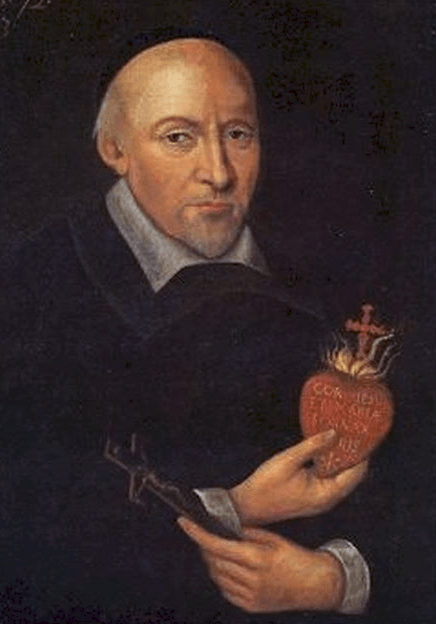
Jean Eudes was born to a Norman peasant family in the Orne, entered the Oratory of Pierre de Bérulle (the French Catholic Reformation foundation modelled on Philip Neri's Roman Oratory) in 1623 at twenty-two, and was ordained priest in 1625. He served the great Norman plague missions of 1625–32 and 1639 with extraordinary courage — at one point sleeping in a barrel in the open fields outside Caen so as not to bring plague into the local Oratorian house — and emerged as the principal Norman missionary preacher of his generation.
In 1641 he founded the Sisters of Our Lady of Charity of the Refuge — a new women's religious congregation dedicated to the rehabilitation of penitent women and prostitutes — a radical Norman pastoral response to a problem that conventional Catholic structures had treated mostly as a problem of police. In 1643 he left the Oratory to found the Congregation of Jesus and Mary (the Eudists) — a society of secular priests modeled on Vincent de Paul's Lazarists, but specifically dedicated to the formation of secular clergy through systematic seminary training. The Eudists became one of the principal Catholic seminary congregations of pre-Revolutionary France.
His theological contribution was the systematic public devotion to the Sacred Hearts of Jesus and Mary together — a development of the older medieval interior tradition of Lutgardis, Gertrude the Great, and Mechtilde of Hackeborn, but made for the first time a formal public liturgical devotion. He composed and published the first Mass and Office of the Sacred Heart of Jesus (1672, twenty years before the visions of Margaret Mary Alacoque at Paray-le-Monial), and the first Mass and Office of the Heart of Mary (1648). He is the principal historical figure in the public-liturgical development of Sacred Heart devotion. He died at Caen on August 19, 1680. Canonized 1925.