
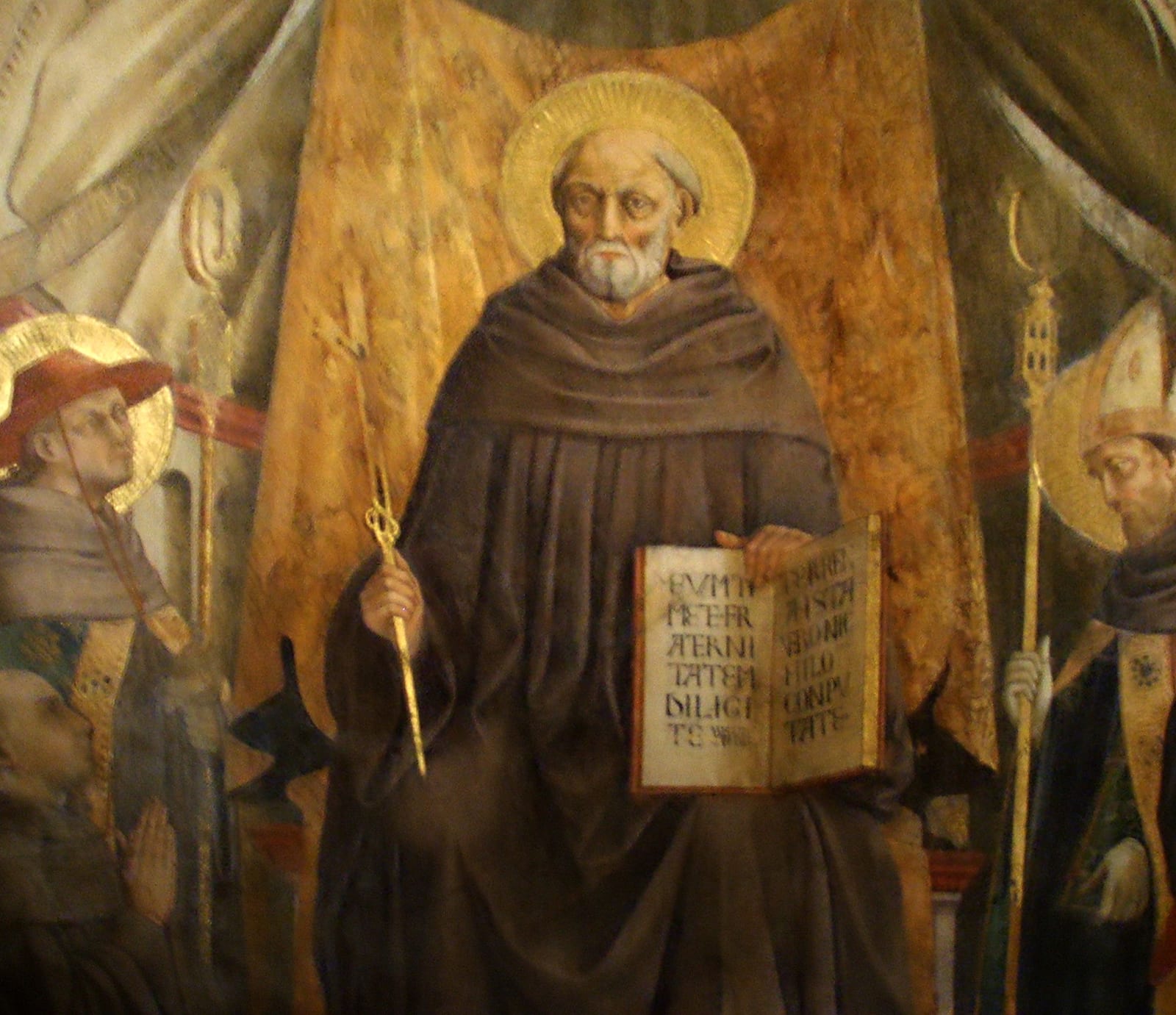
John Gualbert was a young Florentine knight whose brother Hugh was killed in a feud. On Good Friday he rode out to take revenge and met his brother's killer in a narrow lane where neither could escape. The unarmed man fell on his knees and stretched out his arms in the form of a cross, begging mercy 'for the sake of Christ who today asked pardon for His killers.' John lowered his sword, embraced him, and rode on to the nearby church of San Miniato al Monte. There, as he prayed before a Byzantine crucifix, the head of the figure bowed toward him in acknowledgement of his act of mercy. The Crucifix of San Miniato is preserved to this day.
He entered the Benedictine abbey of San Miniato, then left for stricter solitude, eventually settling around 1036 at Vallombrosa ('shadowy valley') in the Apennines above Florence. The community he founded there became the Vallombrosan Congregation — a strict Benedictine reform centered on poverty, enclosure, and lay-brother manual labor. The Vallombrosans were among the most active anti-simoniac voices of the eleventh-century reform.
He died at Passignano in 1073, the same year as Pope Alexander II whose reform party he had supported throughout. He was canonized by Celestine III in 1193, and in 1951 Pope Pius XII made him the universal patron of foresters and park rangers, in recognition of the Vallombrosan tradition of forest cultivation in the Apennines.