
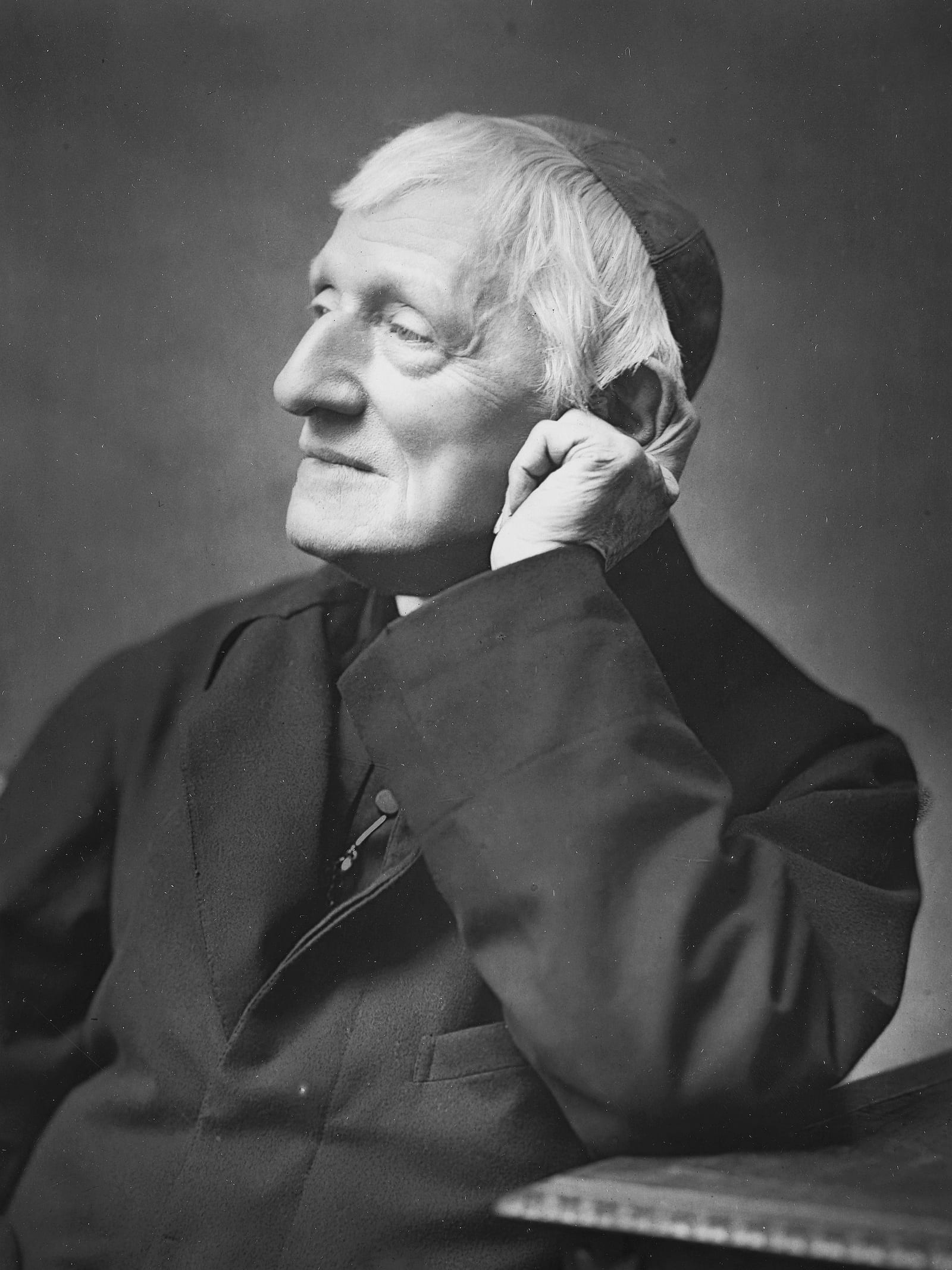
John Henry Newman was born in London to a banker's family and became, at twenty-six, a Fellow of Oriel College, Oxford, then vicar of the University Church of St. Mary the Virgin. From 1833 he was the leading mind of the Oxford Movement — the great Anglican attempt to recover the catholic and apostolic identity of the Church of England. His Tracts for the Times (especially the famous Tract 90 of 1841, arguing that the Thirty-Nine Articles could be read in a Catholic sense) ended his Anglican career.
On October 9, 1845 — after six years of careful study and prayer — he was received into the Catholic Church by Bl. Dominic Barberi, an Italian Passionist visiting Littlemore, the small Oxford-side community where Newman had been living. The reception of the principal intellectual of Oxford into Rome was one of the great theological events of the 19th century.
He was ordained a priest in 1847, founded the English Oratory of St. Philip Neri at Birmingham (1849), wrote the great spiritual autobiography Apologia pro Vita Sua (1864) in response to Charles Kingsley's attack, defended papal infallibility against gallicans and ultramontane extremists alike at Vatican I (1869–70), and was created Cardinal by Leo XIII in 1879. He died at Birmingham in 1890 with the words of his own hymn: 'Lead, kindly Light.'
His canonisation was the second-ever of an English-born saint canonised after the Reformation. Pope Leo XIV declared him a Doctor of the Universal Church on November 1, 2025 — the 38th Doctor and the first English Doctor since Bede (1899). His motto cor ad cor loquitur — 'heart speaks to heart' — became Benedict XVI's homily theme at his 2010 beatification.