
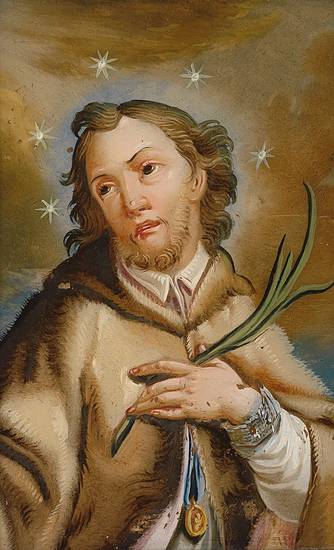
Jan Nepomucký was educated at the University of Prague, ordained priest, and rose through the Prague archdiocesan administration to become vicar-general of the archdiocese under Archbishop John of Jenstein. He was the personal confessor of Queen Sophia of Bavaria, the second wife of King Wenceslas IV of Bohemia — a marriage marked by Wenceslas's notorious drunkenness, paranoia, and violence.
According to the unanimous medieval tradition, Wenceslas demanded that John reveal what the queen had confessed to him. John refused absolutely to break the sacramental seal. He was arrested, tortured personally by the king (who was present at the rack), and on the night of March 20, 1393, was bound, gagged, weighted with a stone, and thrown from the Charles Bridge into the Vltava river to drown. (A second school of historical interpretation — argued especially by 19th-century critical historians — holds that the drowning was the result of a wider dispute over abbey-elections; but the tradition of the confessional seal predates the Counter-Reformation and is recorded in Bohemian chronicles by the early 15th century.)
His body washed up downstream the next day, and a row of seven stars was seen floating above the spot where he had been thrown in (or, in another version, where his body floated). He became the immediate proto-martyr of the seal of confession in Latin Christianity. The Charles Bridge in Prague carries the great Baroque bronze statue of him on the parapet at the place of his martyrdom; his tomb in St. Vitus Cathedral is enclosed in a silver canopy weighing two tons. Canonized in 1729, he is the principal patron saint of Bohemia and Czechia.