
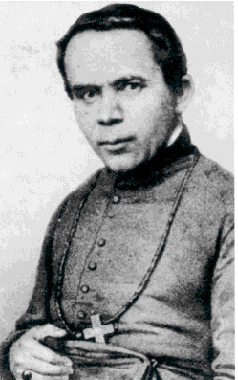
Jan Nepomuk Neumann was born in a small Bohemian town to a German-speaking stocking-maker father and a Czech mother. He grew up speaking eight languages, which would later make him singularly suited to the polyglot Catholic immigrant population of mid-century America. He completed his seminary studies in Prague but, on the eve of his ordination in 1835, the Bishop of Budweis suspended all ordinations — there were already too many priests in Bohemia.
He boarded ship for New York with one suit of clothes and a single dollar. Bishop John Dubois of New York ordained him in 1836 and sent him to the German-speaking Catholics of western New York. For four years he served twenty parishes in the diocese of Buffalo, walking from one to another in all weathers, sometimes celebrating Mass on a tree-stump altar in a forest clearing. In 1840 he entered the Redemptorist Congregation, the first American to do so.
In 1852 Pope Pius IX named him Bishop of Philadelphia against his will. As bishop he opened a parish school in every parish — within ten years his diocese had a hundred schools where it had had two — and laid the foundation of the American Catholic education system that Mother Seton had begun and that Drexel and Cabrini would later continue. He confirmed nearly ninety thousand people, ordained dozens of priests, founded the Forty Hours devotion in the United States, and ran the diocese on foot.
On January 5, 1860, while delivering a chalice to a friend's house on Vine Street, he collapsed on the sidewalk of a stroke. He was forty-eight. Cardinal Wojtyła, future Pope John Paul II, attended his canonization in 1977; one of his own canonization miracles was a Czechoslovak boy named Michael Flanigan, healed of bone cancer in 1963.