
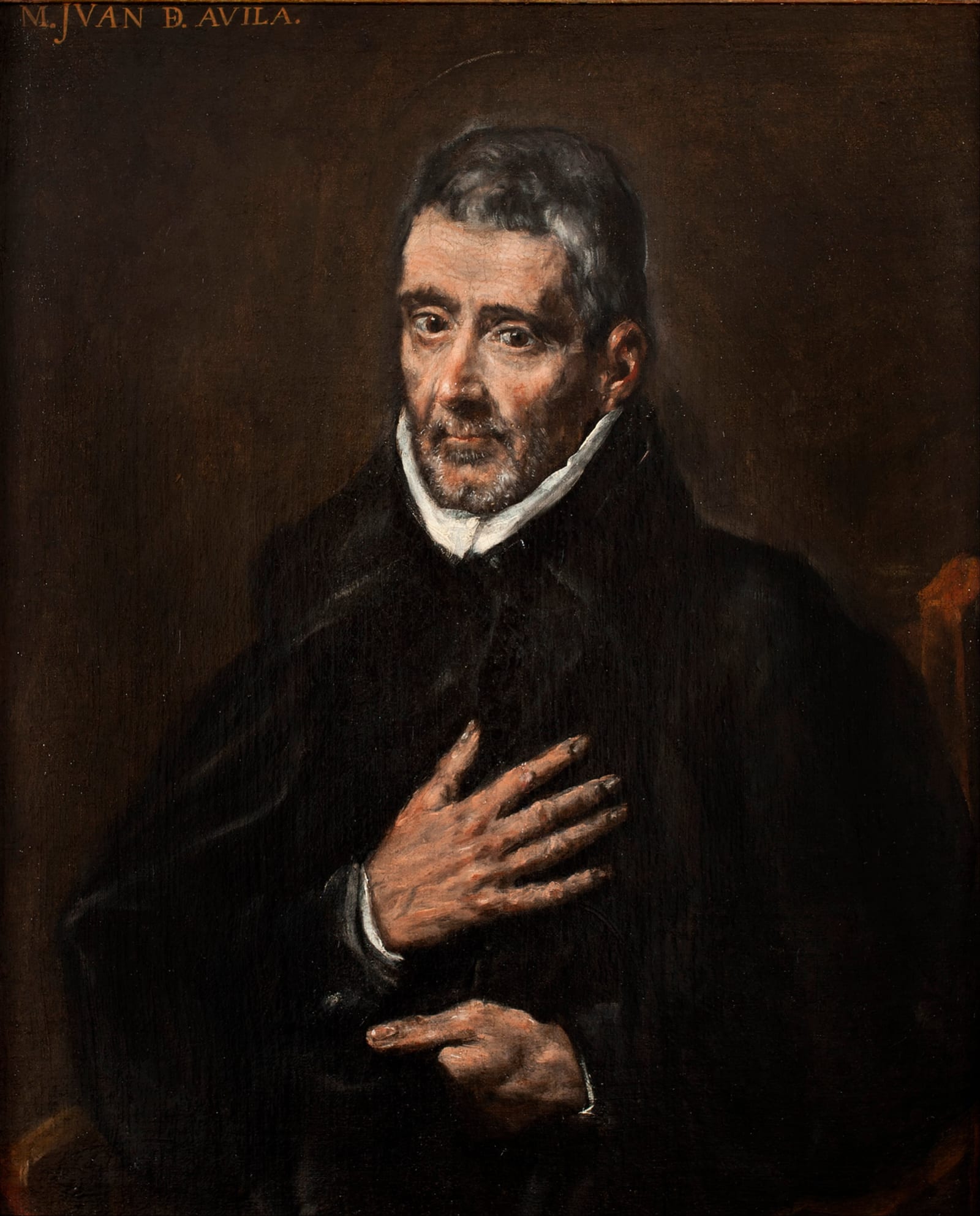
John was born to a wealthy converso (Jewish-Christian) family in La Mancha, an only child of devout parents. Sent to Salamanca for law, he abandoned the studies in favour of theology and devoted himself to a life of austerity. Ordained in 1526, he distributed his entire inheritance to the poor on the day of his first Mass and set off — penniless — for the New World.
Detained in Seville by the Archbishop who recognised his gifts, he never reached the Indies. Instead he spent four decades preaching across Andalusia, becoming the spiritual director of an extraordinary circle: St. Teresa of Ávila, St. John of God (whose conversion he occasioned by a single sermon), St. Francis Borgia, St. Peter of Alcántara, the future St. John of the Cross, and the founder of the Jesuit Constitutions, St. Ignatius Loyola (who consulted him by letter). He was the principal reformer of clerical life in 16th-century Spain.
His three main works — the Audi, filia (a long letter on the interior life, originally written for a Carmelite nun and dedicated later to a noble convert), and two memorials to the Council of Trent on the reform of the clergy and the education of priests — laid out the seminary-formation programme that the Council substantially adopted in its 23rd session (1563).