
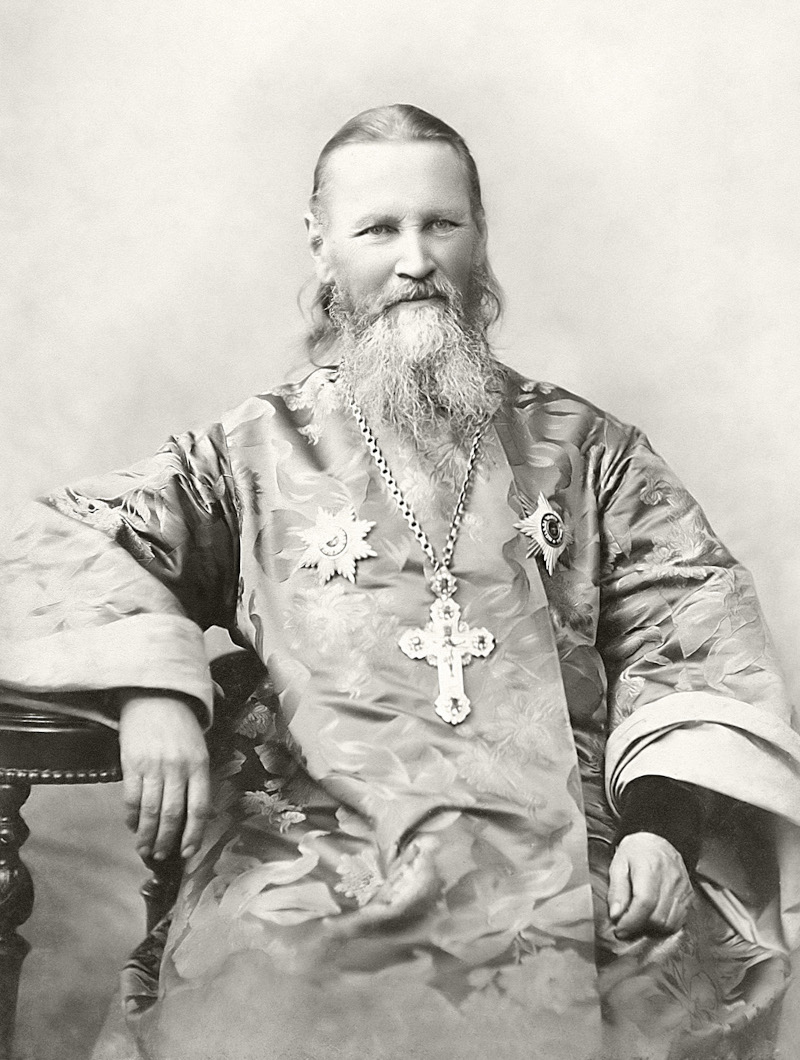
Ivan Ilyich Sergiyev was born to a poor Russian Orthodox sacristan's family in the village of Sura on the Pinega River, far north of Arkhangelsk. He was educated at the Arkhangelsk seminary and the St. Petersburg Theological Academy, ordained priest in 1855, and assigned to St. Andrew's Cathedral at Kronstadt — the great naval base on the island of Kotlin at the head of the Gulf of Finland. He served at the same parish for the remaining fifty-three years of his life — under the local nickname 'Bat'ushka Ioann' ('Father Ivan' — but the Russian dim. form carries an additional affectionate weight).
He transformed Kronstadt from a notorious sailors'-town slum into a model parish through three distinctive innovations of his ministry. First, he was the great Russian Orthodox apostle of the practice of daily reception of Holy Communion at every parish Mass — at a time when the Russian Orthodox average lay reception was at most four times per year. Second, he established the celebrated 'House of Industry' (Dom Trudolyubiya, 1882) — a model integrated facility combining a homeless shelter, work-training programme, free school, free medical clinic, and church for the indigent Kronstadt population. Third, he conducted from 1880 onwards a continuous public ministry of mystical-prophetic discernment in personal direction — receiving up to several hundred visitors per day from across the Russian Empire, with continuous attested phenomena of healings and prophetic insight that made him by 1900 the most-known Russian Orthodox figure in the world.
His Diary of a Country Priest (My Life in Christ, multi-volume, 1893–1908) became the foundational Russian Orthodox modern devotional text — widely read in pre-revolutionary Russia and continuously through the Soviet period. He died at his Kronstadt residence on December 20, 1908. His body was buried at the St. John of Rila monastery on the Karpovka River in St. Petersburg, which he had founded in 1900. The monastery was suppressed by the Soviets in 1923 and the relics buried in concealment; rediscovered in 1990, the relics were translated back to the restored monastery in 1991. Canonized by the Russian Orthodox Church in 1990.