
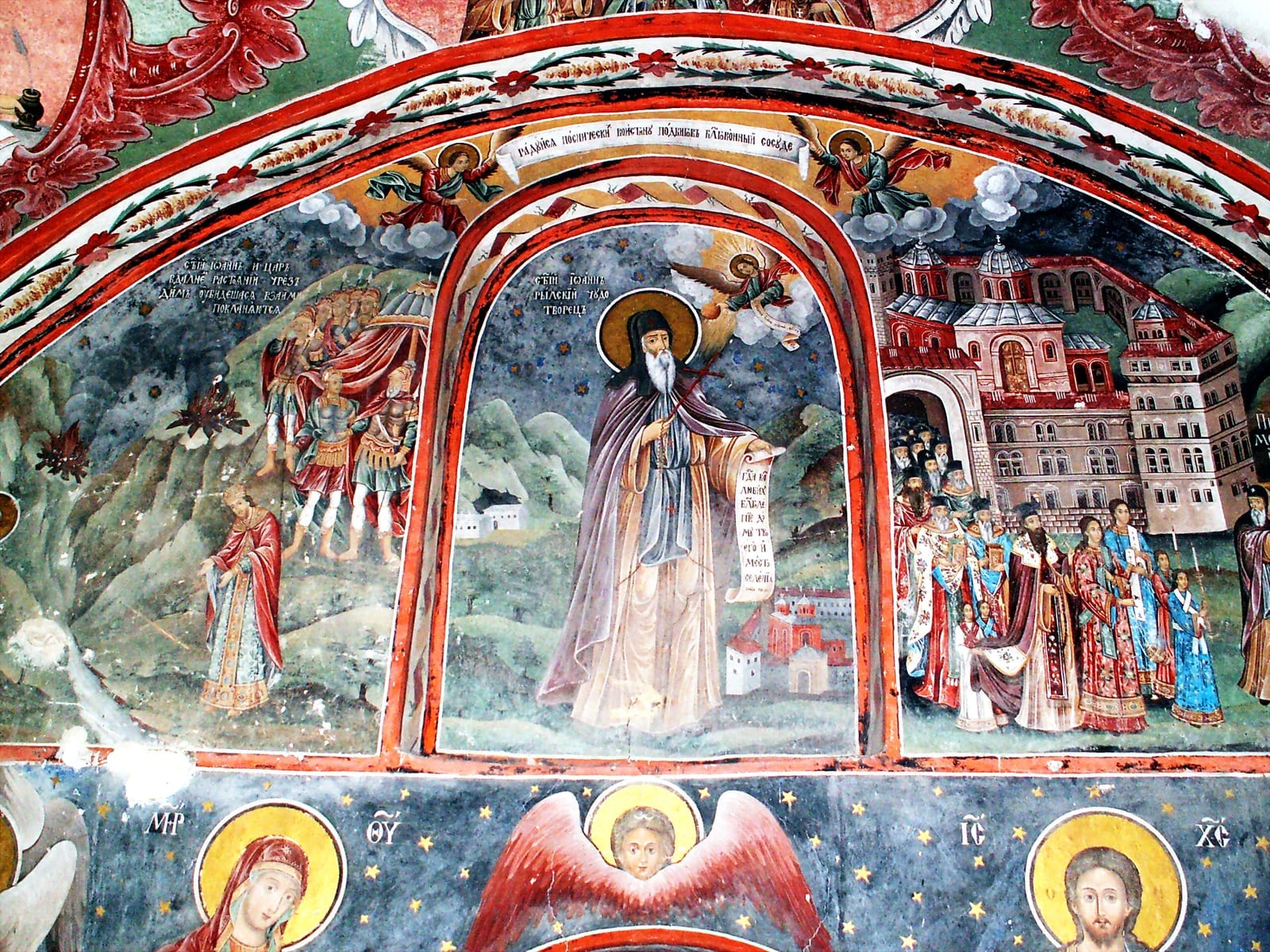
John (Bulgarian Ivan) of Rila was born around 876 in Skrino in the Bulgarian Empire to a Slavic-Bulgarian peasant family. After the death of his parents and the dissolution of his small inheritance, he entered monastic life at the nearby monastery of St. Demetrius of Ruen at the age of 25.
Seeking greater solitude, he withdrew first to a hermit's cave on the mountain of Ruen, then progressively deeper into the Rila Mountains (the central mountain range of Bulgaria) — spending the next thirty years in extreme ascetic solitude in the wild Rila highlands, subsisting on the beans and herbs of the mountain meadows.
Around 927, disciples began finding him in his mountain hermitage; under pressure from the growing community, John founded the Rila Monastery — the principal monastic foundation of medieval Bulgaria.
He was visited by the Bulgarian Tsar Peter I (927–969), who offered him royal gifts; John returned them all, writing to the tsar in his famous Testament to His Disciples (the text surviving in Old Bulgarian Slavonic, one of the principal texts of early Slavonic Catholic-Orthodox spirituality): 'For if a single monk in the wilderness shall own anything privately, he shall be a thief; how much greater the offence if the prince of the monks shall own gold and silver.'
He died at his mountain hermitage on August 18, 946, after 30 years of mountain-solitary asceticism and 19 years of hermit-abbot leadership of the Rila community. His relics were translated to the Bulgarian capital Sredec (modern Sofia) in 980 by Tsar Peter II — and again translated to Hungarian Esztergom in 1183 (after the Byzantine reconquest of Bulgaria), then returned to Rila Monastery in 1469.