
MIRACULOUS MIRACLES™

Saint — John of the Cross

St. John of the Cross
June 24, 1542, Fontiveros — December 14, 1591, Úbeda
Doctor Mysticus — the Mystical Doctor
Convent of the Discalced Carmelites, Segovia, Spain
Feast
December 14
Canonized
December 27, 1726 (by Benedict XIII); Doctor 1926 (by Pius XI)
Doctor of the Church
Yes
Life

Juan de Yepes was born to a poor weaver's family in Old Castile; his father died when he was a small child, and the family lived in extreme deprivation. He worked as a nurse in a hospital for syphilitics while studying at the Jesuit college of Medina del Campo, and at twenty-one entered the Carmelite Order, taking the name Juan de San Matías.

Drawn to even greater austerity than the Carmelite life offered, he was about to leave for the Carthusians when, in 1567, he met St. Teresa of Ávila. She was twenty-seven years his senior and had just begun her reform of the women's Carmelites. She persuaded him to undertake the same reform for the men. In November 1568, with two companions, he opened the first Discalced Carmelite house for friars at Duruelo, taking the new name Juan de la Cruz.

Persecuted by the unreformed Carmelite establishment, he was kidnapped in 1577 and held in a tiny cell of nine by five feet in a Toledo monastery for nine months. There — by candlelight smuggled in by his jailer — he composed the first thirty-one stanzas of the Spiritual Canticle, some of the greatest religious poetry in the Spanish language. He escaped after nine months of beatings and isolation, and spent the rest of his life writing the commentaries on his own poems that are his theological masterpieces: The Ascent of Mount Carmel, The Dark Night of the Soul, The Spiritual Canticle, The Living Flame of Love. He died at forty-nine of an infected leg.

Miracles & Phenomena
  • The Toledo Cell Compositions (1577–78)

    1577–1578

    In nine months of brutal imprisonment, on smuggled scraps of paper by candlelight, he composed the Spiritual Canticle — among the supreme achievements of Spanish literature — and conceived the structure of the Dark Night.

  • Voice of Christ from the Crucifix

    Praying before a crucifix in the church at Segovia, John heard Christ ask: 'Brother John, what would you have for the labours you have undertaken for me?' He answered: 'Lord, only to suffer and be despised for you.'

Relics
  • Body
    Tomb of St. John of the Cross
    Convent of the Discalced Carmelites, Segovia, Spain

    The main relic — the body — rests in a sumptuous neo-Plateresque sepulchre completed in 1927 for the bicentennial of his canonization. Sections of his body are also kept at Úbeda (a hand and a leg, by an early ecclesiastical compromise between the two towns).

  • Bodily relic
    Hand and leg
    Oratory of San Juan de la Cruz, Úbeda, Andalusia
Iconography
  • John with the Crucifix and the Pen

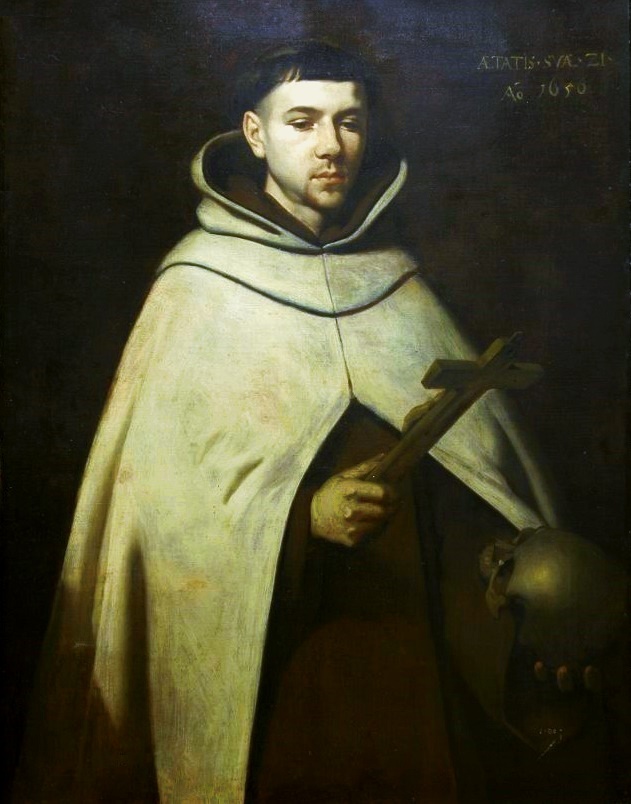
    His invariable attributes — the brown Carmelite habit with bare feet (the 'discalced'), a crucifix in his hand or on his desk, and a quill. Often shown gazing at a crucifix in the air.

  • Christ of St. John of the Cross
    St. John of the Cross (drawing, c. 1574); Salvador Dalí (painting, 1951) · Encarnación Convent, Ávila (original drawing)

    His own small ink drawing of the crucified Christ — viewed from above, as if from the Father's perspective — survives at Ávila. Salvador Dalí transformed it into one of the most recognised religious paintings of the 20th century (Glasgow Museums, 1951).

Prayers to This Saint
Patronages
Spanish poets and contemplativesMysticsFontiverosÚbeda and Segovia
Sources & Further Reading