
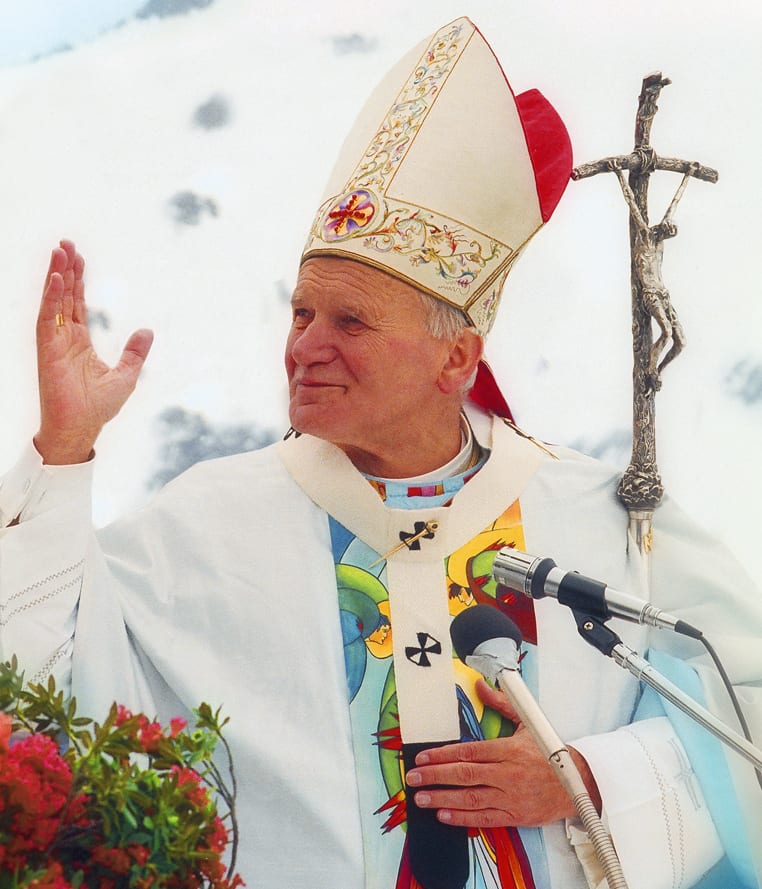
Karol Józef Wojtyła was born in Wadowice, southern Poland, in the year that the young Polish republic was fighting to survive Soviet invasion. His mother died when he was eight, his only brother when he was twelve, his father when he was twenty. He grew up speaking Polish, German, Hebrew, Russian, and the prayer of the Jewish neighbours among whom he played.
During the German occupation he studied for the priesthood in secret, working by day in a stone quarry and then a chemical factory. Ordained in 1946, he became professor of ethics, then auxiliary bishop of Kraków (1958), then archbishop (1964), then cardinal (1967). At the Second Vatican Council he was a key voice on religious liberty and the dignity of the human person.
On October 16, 1978, after the thirty-three-day pontificate of John Paul I, he was elected pope — the first non-Italian in 455 years and the first Slavic pope ever. His twenty-seven-year reign (the second-longest in history) reshaped the world: he visited 129 countries, contributed decisively to the fall of European communism, met for the first time with leaders of every major world religion, instituted World Youth Day, the Mysteries of Light, and the Catechism of the Catholic Church, and beatified and canonised more people than all his predecessors combined.
He survived an assassination attempt by Mehmet Ali Ağca on May 13, 1981 — the feast of Our Lady of Fátima — and forgave his attacker in person in his prison cell. He died on the vigil of Divine Mercy Sunday, April 2, 2005, having spent his final years suffering publicly with Parkinson's disease. Beatified 2011 and canonised 2014, both on Divine Mercy Sunday.