John Scotus 'Eriugena' (Irish-born) was the supreme philosopher of the Carolingian world. Brought from Ireland by King Charles the Bald around 845 as master of the palace school at Laon, he was the only thinker of his century with full command of Greek.
At Charles's commission he translated into Latin the entire corpus of Pseudo-Dionysius the Areopagite — the four great Greek treatises on mystical theology that became foundational to medieval Latin contemplative tradition — and the works of Maximus the Confessor. Through his translation Pseudo-Dionysius reached Western theologians from Hugh of St. Victor to Aquinas to John of the Cross.
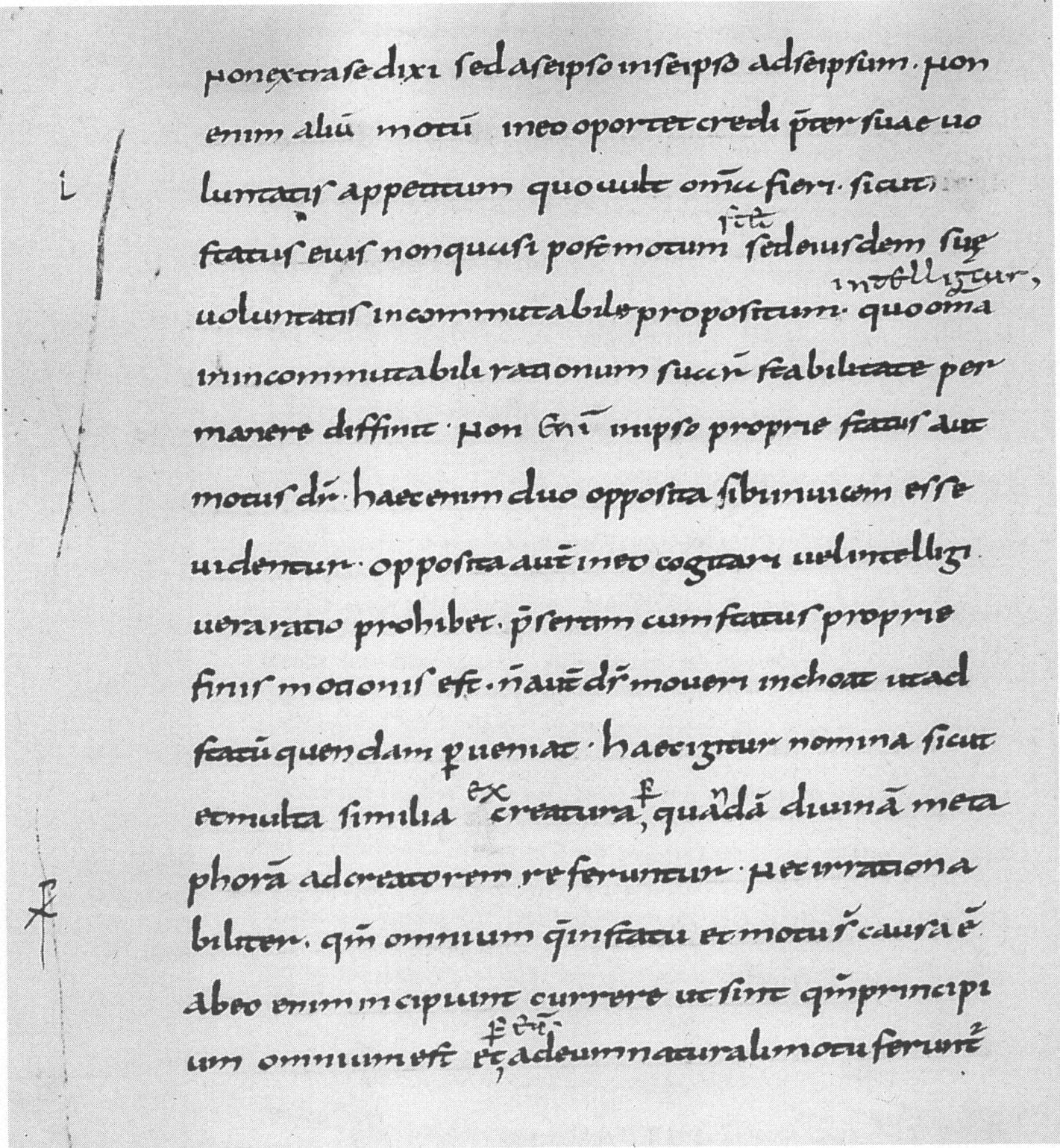
His own great philosophical synthesis, Periphyseon ('On the Division of Nature,' c. 867), is the most ambitious Latin metaphysical work between Augustine and Aquinas — and it was condemned. His teaching on predestination had already been condemned by the councils of Valence (855) and Langres (859), and in 1225 the Periphyseon itself was condemned for pantheism. His translations escaped condemnation.
Nothing certain is known of his death. The story William of Malmesbury told in the twelfth century, that he went to England at King Alfred's invitation and was stabbed to death by his pupils' pens, 'has no support in contemporary documents' (Catholic Encyclopedia). He holds no title from the Church: he is a great mind of the Church's history, not one of her Blesseds.