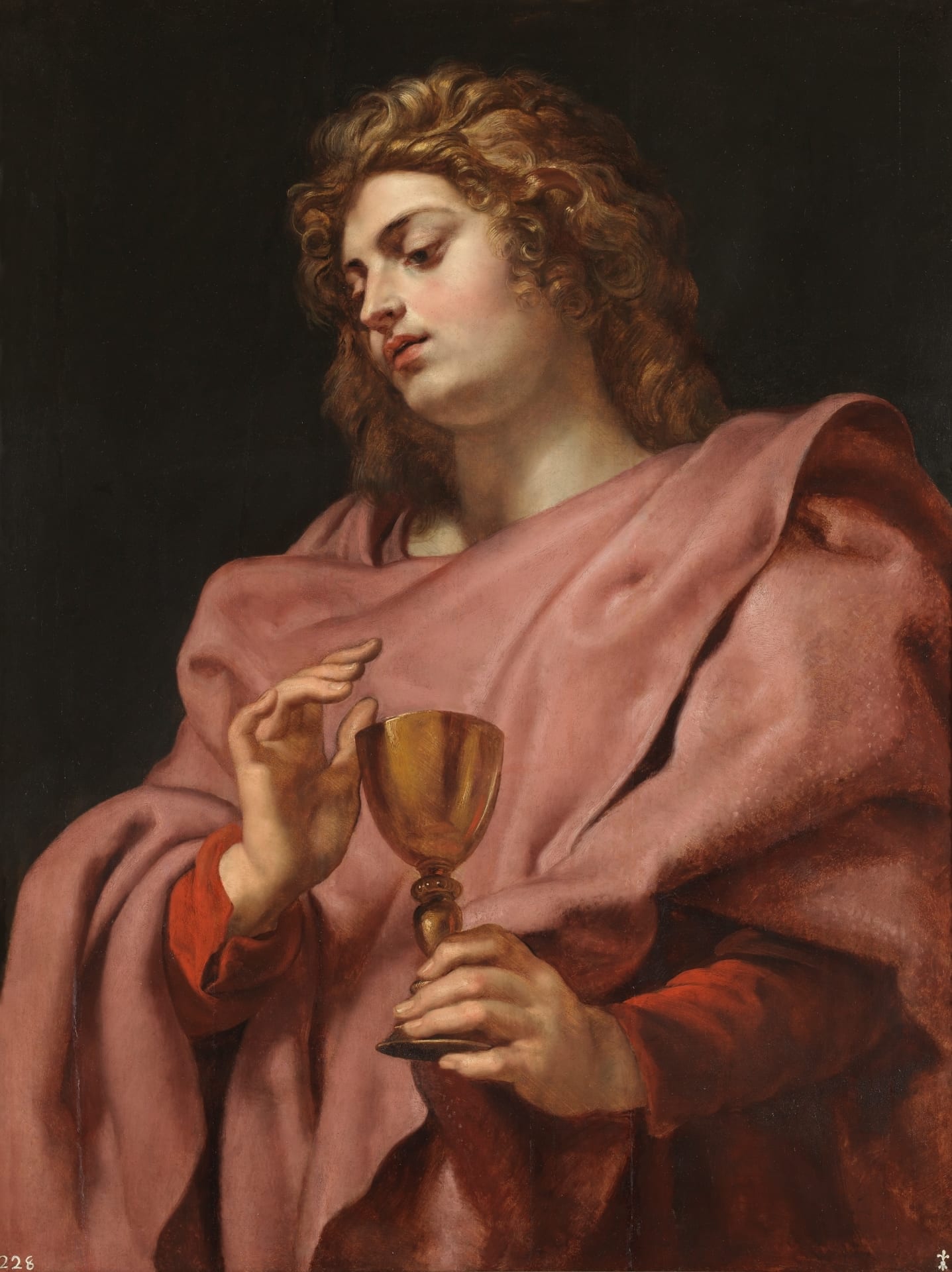
John, son of Zebedee, was the younger brother of James the Greater and, with Andrew, one of the first disciples John the Baptist sent to Jesus. He is the 'beloved disciple' of the Fourth Gospel — the one who leaned on the breast of Christ at the Last Supper, the only apostle to stand at the foot of the Cross, the one to whom the dying Christ entrusted his Mother: 'Behold your son... Behold your mother' (John 19:26–27).
He was the first of the apostles to reach the empty tomb on Easter morning and the first to recognise the risen Christ on the Sea of Galilee. Tradition unanimously holds that after caring for the Blessed Virgin Mary he settled at Ephesus, became bishop there, and was the only apostle to die a natural death.
He authored the Fourth Gospel, three letters (1, 2, 3 John), and — exiled to the island of Patmos under Domitian — the Apocalypse / Book of Revelation. Tradition holds that in his extreme old age, when he could no longer preach long sermons, he would say simply at every gathering: 'Little children, love one another.'
At the Empty Tomb
Running with Peter to the empty tomb on Easter morning, John outran Peter, looked in, and 'saw and believed' (John 20:8) — the first apostle to come to faith in the Resurrection through the evidence of the linen cloths.
The Cup of Poison
An early tradition (preserved by Isidore of Seville and visually in Christian iconography) holds that the high priest at Ephesus offered John a cup of poison to test his faith. John blessed the cup; the poison rose from it in the form of a serpent, and he drank without harm.
The Cauldron of Boiling Oil
Tertullian records the tradition that John was brought to Rome under Domitian and was plunged into a cauldron of boiling oil at the Porta Latina — and emerged unharmed. He was then exiled to Patmos. A small Roman church, San Giovanni in Oleo, marks the traditional spot.
The 'Manna' of John's Tomb
From at least the time of St. Augustine and Gregory of Tours, pilgrims to Ephesus reported that a sweet-smelling dust (the 'manna' of John) issued from his tomb on his Eastern feast day, May 8 — the source of many healings. The feast was kept in the East to commemorate the miracle.
Sources & Further Reading