
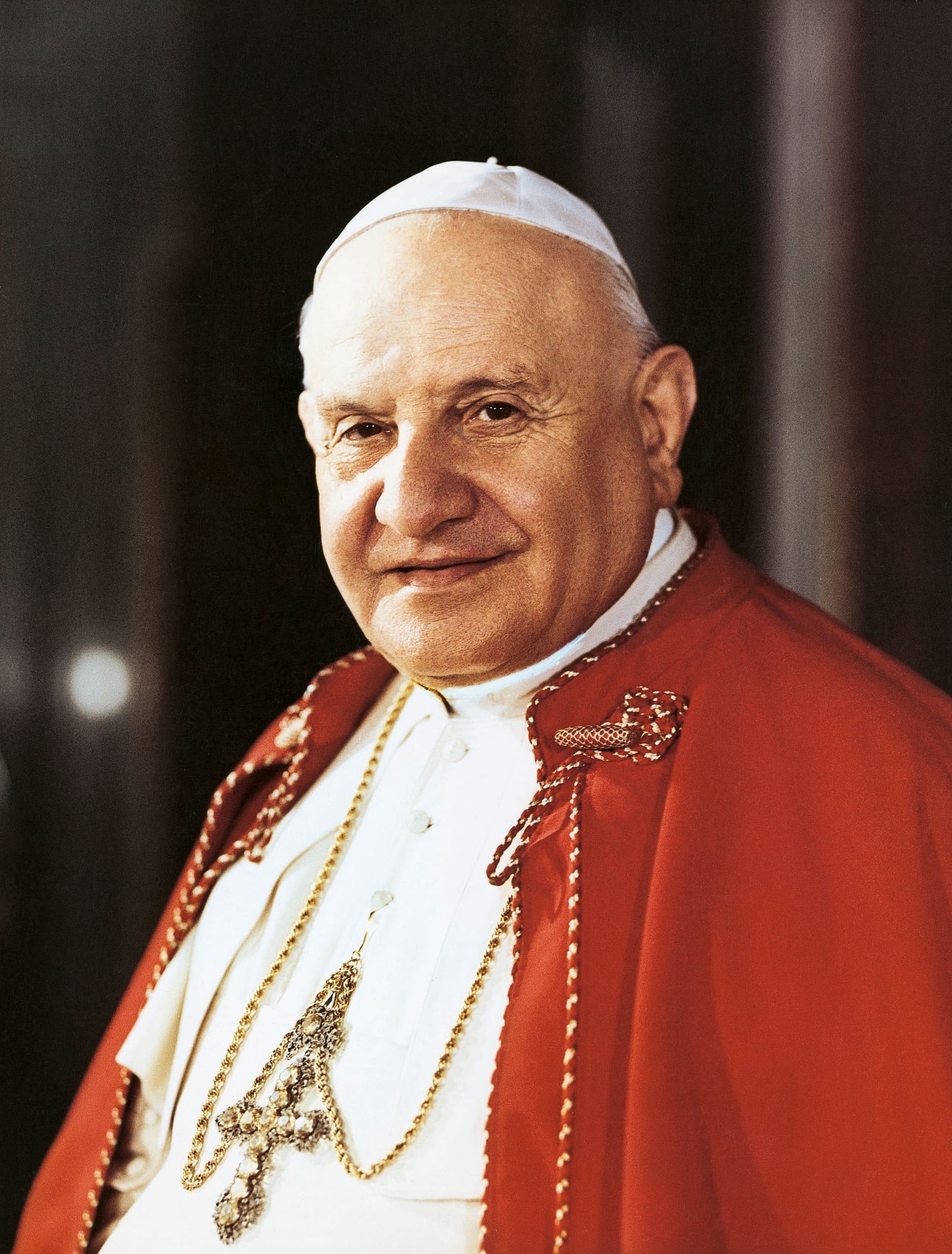
Angelo Giuseppe Roncalli was the fourth of fourteen children born to sharecroppers in the Bergamasque foothills. Ordained in 1904, he served as secretary to the bishop of Bergamo, then as a sergeant medic in the Italian army during the First World War, then — for almost three decades — in the Vatican diplomatic service in Bulgaria, Turkey/Greece, and France. As nuncio at Istanbul during the Second World War he forged baptismal certificates and travel permits to save thousands of Jewish lives, especially of children, transporting them to Palestine through Bulgaria.
Made Patriarch of Venice in 1953, he was elected pope at seventy-six in October 1958, a 'transitional' choice by cardinals deadlocked between progressive and conservative candidates. He took the name John — abandoned for over five hundred years since the antipope John XXIII of the Western Schism — and confounded every expectation.
On January 25, 1959, three months into his pontificate, he announced the convocation of an Ecumenical Council. The Second Vatican Council opened on October 11, 1962. He did not live to see its conclusion: he died on June 3, 1963, of stomach cancer, after a long and public dying. The 'pope of openness' has been credited with transforming the relationship of the Catholic Church to the modern world.
Canonised by Francis on April 27, 2014, jointly with John Paul II. Francis waived the second-miracle requirement in his case, recognising the convocation of the Council itself as the sufficient charism. His body, exhumed in 2000, was found 'remarkably preserved' (the Church does not call it formally incorrupt but its preservation was noted) and is now visible beneath the altar of St. Jerome in St. Peter's.