
MIRACULOUS MIRACLES™

Saint — Bl. Jordan of Saxony

Bl. Jordan of Saxony
c. 1190 AD, Saxony (noble Saxon family — probably the von Eberstein or von Borrentrup family) — February 13, 1237 AD, shipwrecked in a storm off the coast of Syria (the Crusader Kingdom), en route from Cyprus to the Holy Land
Second Master of the Order of Preachers (1222–1237); institutional consolidator of the Dominican Order
Convent of Saint-Jacques, Paris — the Dominican convent (destroyed in the French Revolution) where Jordan spent much of his Master-of-the-Order tenure; current Dominican mother-house at Santa Sabina, Rome, Italy
Feast
February 15
Canonized
Beatified May 10, 1826 by Pope Leo XII
Life

Jordan was born around 1190 to a noble Saxon family. Educated at the University of Paris — the principal centre of Catholic scholastic learning of the early 13th century — he received the Master of Theology degree.

In Lent 1220, Jordan received the Dominican habit at the Dominican convent of Saint-Jacques in Paris — personally admitted to the Order by Bl. Reginald of Orléans (just before Reginald's death on February 1, 1220). Jordan rapidly rose in the Order: appointed Provincial of Lombardy in 1221, then — on the death of St. Dominic on August 6, 1221 — elected second Master of the Order of Preachers at the Bologna general chapter of 1222.

Jordan's fifteen-year mastership (1222–1237) consolidated the Dominican Order institutionally after the death of its founder. Under his governance, the Order expanded from approximately 20 to over 300 convents across Catholic Europe — producing the characteristic institutional geographical spread that would underpin the Dominican-scholastic-university tradition.

Jordan was famous for his vocation-recruitment preaching at the University of Paris — producing the famous burst of Paris student-Dominican vocations that became the stream of Dominican intellectual talent feeding the Paris-Dominican tradition (including Sts. Albert the Great, Thomas Aquinas, and dozens of other Paris-trained early Dominicans).

He composed the Libellus de Principiis Ordinis Praedicatorum (Little Book on the Origins of the Order of Preachers, c. 1233) — the first Latin biography of St. Dominic and the principal source for the Dominic-life narrative; and the famous Encyclica letters to the Order.

Jordan is most personally famous in the medieval Dominican tradition for his personal correspondence with Bl. Diana d'Andalò (1201–1236, the aristocratic Bolognese woman who became the foundress of the first Dominican women's-monastic convent of San Sisto at Bologna). The fifty surviving letters of Jordan to Diana (composed 1222–1236) constitute one of the principal medieval Catholic spiritual-friendship correspondences — analogous to the Bernard-of-Clairvaux / William-of-Saint-Thierry and Aelred-of-Rievaulx / Simon-Grammaticus spiritual-friendship traditions.

Returning from a Master's-visitation to the Dominican convents of Cyprus and the Holy Land, Jordan was shipwrecked in a storm off the coast of Syria on February 13, 1237. His body was recovered from the shipwreck and buried at the Dominican convent of Acre — the last Crusader-Kingdom capital.

Miracles & Phenomena
  • The institutional consolidation and expansion of the Dominican Order

    Bl. Jordan of Saxony's fifteen-year mastership (1222–1237) — expanding the Order of Preachers from approximately 20 to over 300 convents across Catholic Europe — institutionally consolidated the Dominican Order after the death of its founder. The Jordan-period expansion produced the characteristic institutional geographical spread that would underpin the 800-year Dominican tradition and the Dominican-scholastic-university tradition.

  • The correspondence with Bl. Diana d'Andalò

    Jordan of Saxony's personal correspondence with Bl. Diana d'Andalò (1201–1236, foundress of the Dominican women's-monastic convent of San Sisto at Bologna) — fifty surviving Latin letters composed 1222–1236 — constitutes one of the principal medieval Catholic spiritual-friendship correspondences. The letters illustrate the specifically Catholic 13th-century spiritual-friendship between the Master-General of the Dominican Order and the foundress of the first Dominican women's-monastic community, analogous to the earlier Christina-of-Markyate-and-Geoffrey-of-Saint-Albans and contemporary Franciscan Francis-and-Clare spiritual-friendship traditions.

Relics
  • Body
    Tomb of Bl. Jordan of Saxony
    Originally Dominican Convent of Acre (1237 burial); the convent destroyed in the 1291 Muslim reconquest of Acre; fragmentary relics lost; memorial veneration in the Dominican Order houses worldwide

    His principal tomb at the Dominican convent of Acre was destroyed in the 1291 Muslim reconquest of Acre and the Mamluk destruction of the Crusader Kingdom; fragmentary relics lost; memorial veneration is maintained in the Dominican Order houses worldwide.

Iconography
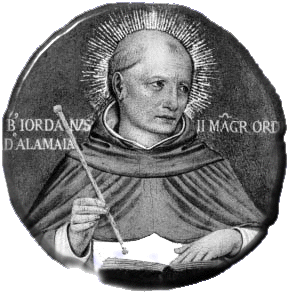
  • Jordan preaching at the University of Paris

    The early-13th-century Dominican Master-General in Dominican black-and-white habit at the Convent of Saint-Jacques at the University of Paris preaching the vocation-recruitment sermon to the young Paris students, the future Sts. Albert the Great and Thomas Aquinas among the listening students — the standard Dominican iconography of vocation-preaching.

Patronages
Order of Preachers (Dominicans) — second Master and institutional consolidatorCatholic vocations to religious life (his famous personal correspondence with Bl. Diana d'Andalò, one of the principal medieval spiritual-friendship correspondences)Catholic University of Paris students (his famous preaching produced dozens of Paris student-Dominican vocations)