
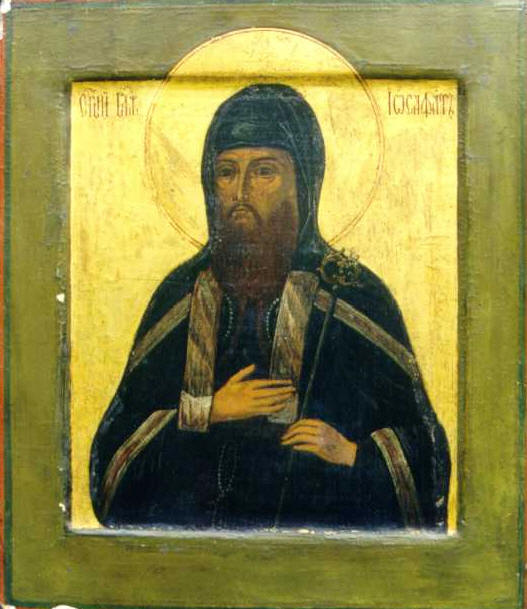
Ioann Kuncevyč was born to a Ruthenian merchant family at Volodymyr-Volynskyi in what is now western Ukraine, in the years immediately following the Union of Brest (1596) — the agreement by which a portion of the Orthodox hierarchy of the Polish-Lithuanian Commonwealth had entered into communion with Rome while retaining the Byzantine liturgy and customs (forming what is now called the Ukrainian Greek Catholic Church or Greek Catholic Church of Belarus). He entered the Basilian Order at Vilnius in 1604, taking the religious name Josaphat.
He was ordained priest in 1609 and rose rapidly: archimandrite of the Monastery of the Holy Trinity in Vilnius in 1614, then Archbishop of Polotsk (in modern Belarus) from 1618 — over a vast eastern frontier diocese with mixed Catholic and Orthodox populations. He worked tirelessly for the integration of Ruthenian Catholic life with Rome while strictly preserving the Byzantine liturgical heritage: opposing both Latinization (against the Polish-Latin clergy) and the Orthodox-aligned Ruthenian movement that resisted the Union.
The Orthodox movement in Ruthenia found a vigorous proponent in the new (rival) Orthodox archbishop of Polotsk, Meletius Smotrytsky. Tensions in the Belarusian-Ruthenian cities of Vitebsk, Polotsk, and Mogilev rose through 1622–23. On November 12, 1623, a mob led by Orthodox militants in Vitebsk broke into Josaphat's residence, killed him with an axe to the head, mutilated his body, and threw it into the Dvina river. The body was recovered downriver. His martyrdom — the first major Catholic-Orthodox blood-shedding of the early modern period — became a watershed in the development of the Greek Catholic identity. Canonized by Pius IX in 1867 — the first Eastern Catholic canonized formally by the Latin papacy. His body now rests in St. Peter's Basilica.