
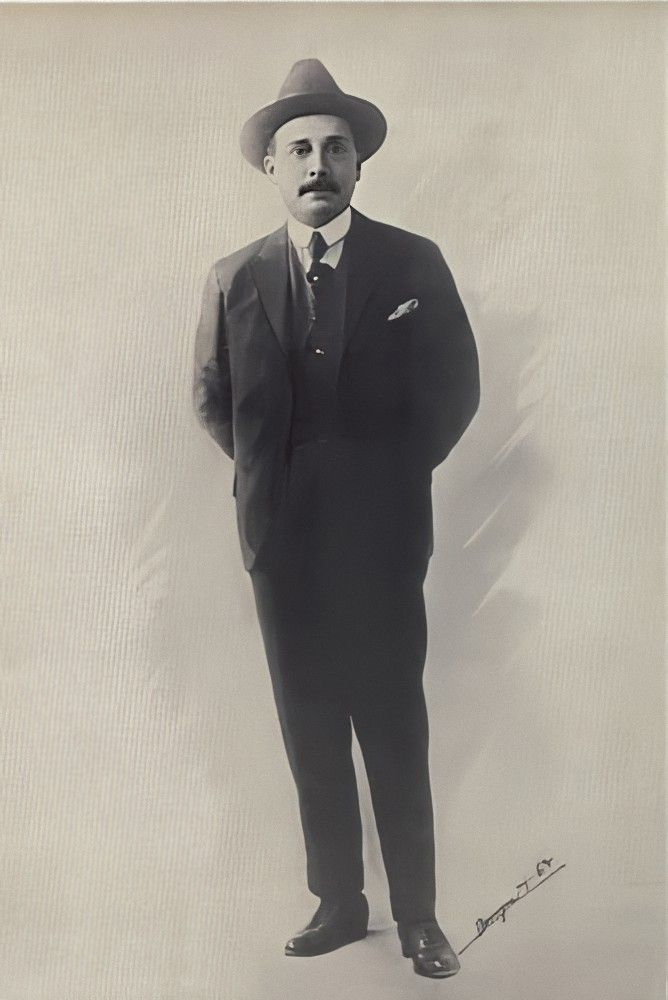
José Gregorio Hernández Cisneros was born on October 26, 1864 at Isnotú, a hill town in the Andean state of Trujillo, Venezuela. At fourteen he was sent to Caracas, entering the Colegio Villegas in 1878, and from there he went on to the university, graduating in medicine in 1888.
The government sent him to Paris in 1889, where he studied under Professor Mathias Duval. He came home with the microscope, the methods and the textbooks of the new laboratory medicine, and at the university in Caracas he founded and held the chairs of histology, pathology, experimental physiology and bacteriology — the beginning of scientific medicine in Venezuela.
Alongside the laboratory he kept a daily practice among the poor of Caracas, charging nothing to those who could not pay and often buying their medicines himself. The city gave him the name that has never left him: el médico de los pobres, the doctor of the poor.
He wanted more than once to be a priest. On July 16, 1908 he entered the Carthusian monastery of Farneta near Lucca as Brother Marcello, but his health broke within months and he was sent home. In 1913 he tried again at the Pio Latino-Americano College in Rome, and again could not stay. He returned to his patients and his students in Caracas and accepted that this was the life asked of him.
On June 29, 1919, crossing a street in Caracas carrying medicine he had just bought for a patient, he was struck by a car and died. The whole city followed his coffin. His remains were later brought from the cemetery to the church of Our Lady of Candelaria, where his tomb stands today.
Pope John Paul II declared him Venerable on January 16, 1986. On June 19, 2020 Pope Francis approved a miracle worked through his intercession, and he was beatified in Caracas on April 30, 2021 — in the small church of the Colegio La Salle rather than the planned stadium, because of the pandemic, with the Nuncio, Archbishop Aldo Giordano, presiding in place of Cardinal Parolin, who could not travel. In his message that day Pope Francis called him 'a man of universal service' and 'a model of personal goodness and civic and religious virtues'.
On February 25, 2025 Pope Francis, accepting the vote of the cardinals and bishops of the Dicastery for the Causes of Saints, approved his canonisation; Pope Leo XIV fixed the date at the consistory of June 13, 2025 and inscribed him among the saints in St. Peter's Square on October 19, 2025, the first Venezuelan to be canonised, together with the Venezuelan foundress María Carmen Rendiles. In his homily Leo XIV named him, with Bartolo Longo, among the new saints who 'with their hearts burning with devotion, are benefactors of humanity'.