
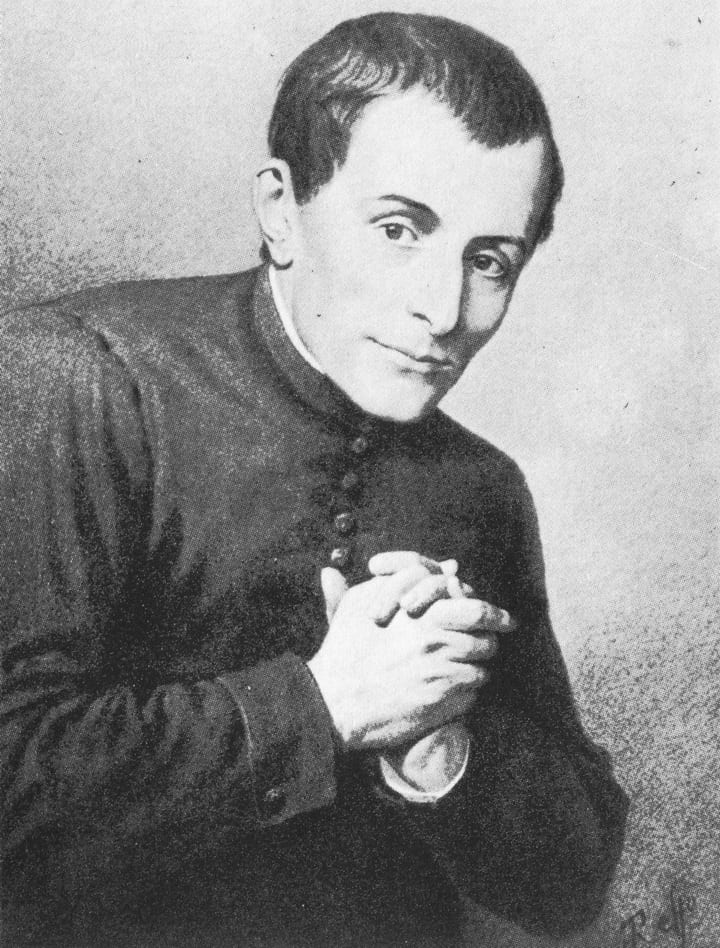
Giuseppe Cafasso was born to a small peasant family in the same village as the future Don Bosco — Castelnuovo d'Asti (now Castelnuovo Don Bosco) in the Asti hills. He was ordained priest in 1833, did postgraduate work at the Convitto Ecclesiastico of Turin (the post-ordination training centre for diocesan clergy), and remained at the Convitto for his entire priestly life — from 1836 as professor of moral theology and from 1848 as rector.
He was the principal spiritual director of an entire generation of Piedmontese Catholic priests — including most famously Don Bosco himself, who began studies under Cafasso in 1841 and remained under his direction until Cafasso's death. Cafasso's moral theology — a careful balanced re-reading of Alphonsus Liguori against both Jansenist rigorism and the laxer continental schools — became the standard for 19th-century Italian Catholic clerical formation. He published the influential Manuale Pratico del Confessore (1860).
His distinctive personal ministry was to the prisoners of the Turin city prison and especially to the condemned to death. He spent his nights with the condemned, hearing their confessions, walking with them to the gallows or guillotine, and supporting them through the moment of execution. The 60 condemned to death he attended across twenty years all died, by his own account, reconciled to God — the famous 'sixty hanged saints' of Cafasso's record. He died of acute illness at the Convitto on June 23, 1860 at forty-nine. Canonized 1947 by Pius XII as part of the Salesian Turin trio (with Don Bosco and Dominic Savio) of the 19th-century Piedmontese pastoral revival.