
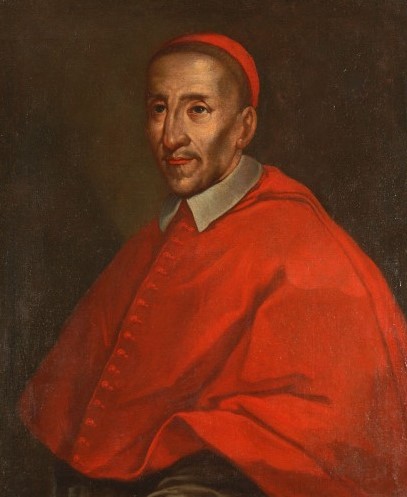
Giuseppe Maria Tomasi was the eldest son of the Duke of Palma di Montechiaro in Sicily and renounced his title and inheritance at fifteen to enter the Theatines at Palermo in 1665. The cession he signed (passing all hereditary rights to his sister) is preserved as one of the most graceful documents of Sicilian noble piety of the period. He served the Theatines as Greek and Hebrew teacher, parish preacher, and superior at various Italian houses over forty years.
His distinctive intellectual contribution was as a pioneer of early modern Catholic liturgical scholarship. His critical editions of the Roman Psalter (1683), the Roman Sacramentaries (1680), the Antiphonary (1686), the Roman Responsoriale (1686), and the Cassinese Sacramentary (1691) re-discovered for the early modern Latin Church the early medieval Western liturgical sources — work that prefigured by nearly three centuries the historical-liturgical retrieval that would shape the 20th-century liturgical movement and the Vatican II reforms. He was consulted as the leading liturgical scholar by Innocent XI, Innocent XII, and Clement XI.
Clement XI created him cardinal in 1712 against his strenuous opposition — Tomasi accepted only when explicitly commanded under obedience by his Theatine superior. He served less than a year, dying at Rome on January 1, 1713. Canonized 1986. His mother Rosalia and his sister Isabella also developed cults of mystical sanctity within the broader Sicilian noble Tomasi-Lampedusa family — recorded in Giuseppe Tomasi di Lampedusa's classic novel Il Gattopardo (The Leopard), which is structured around a great-great-nephew of Joseph Mary Tomasi.