
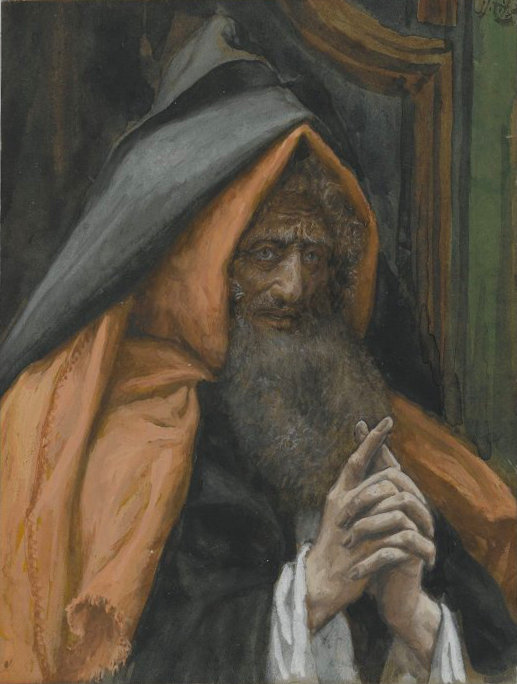
Joseph of Arimathea was 'a rich man... who himself also was a disciple of Jesus' (Mt 27:57) — a member of the Sanhedrin (Mk 15:43) who had not consented to their counsel against Christ. He was 'a good and a just man' (Lk 23:50–51) who looked for the kingdom of God.
After the death of Christ on the Cross he went boldly to Pilate and asked for the body of Jesus. Pilate gave it to him. With Nicodemus he took the body down, wrapped it in fine linen with a hundred pounds of myrrh and aloes, and laid it in his own new tomb hewn in the rock, where no man had yet been laid (Jn 19:38–42). He rolled a great stone to the door and went his way.
Medieval English tradition extended his story far beyond the Gospels: Joseph of Arimathea, by this account, came to Britain as a missionary, bringing with him the Holy Grail, the chalice of the Last Supper, and founded the first Christian church at Glastonbury — where his staff, struck into the ground, took root and became the Glastonbury Thorn that flowers each Christmas Day. The historical evidence is slight; the devotional tradition has shaped a thousand years of English Catholic piety.