
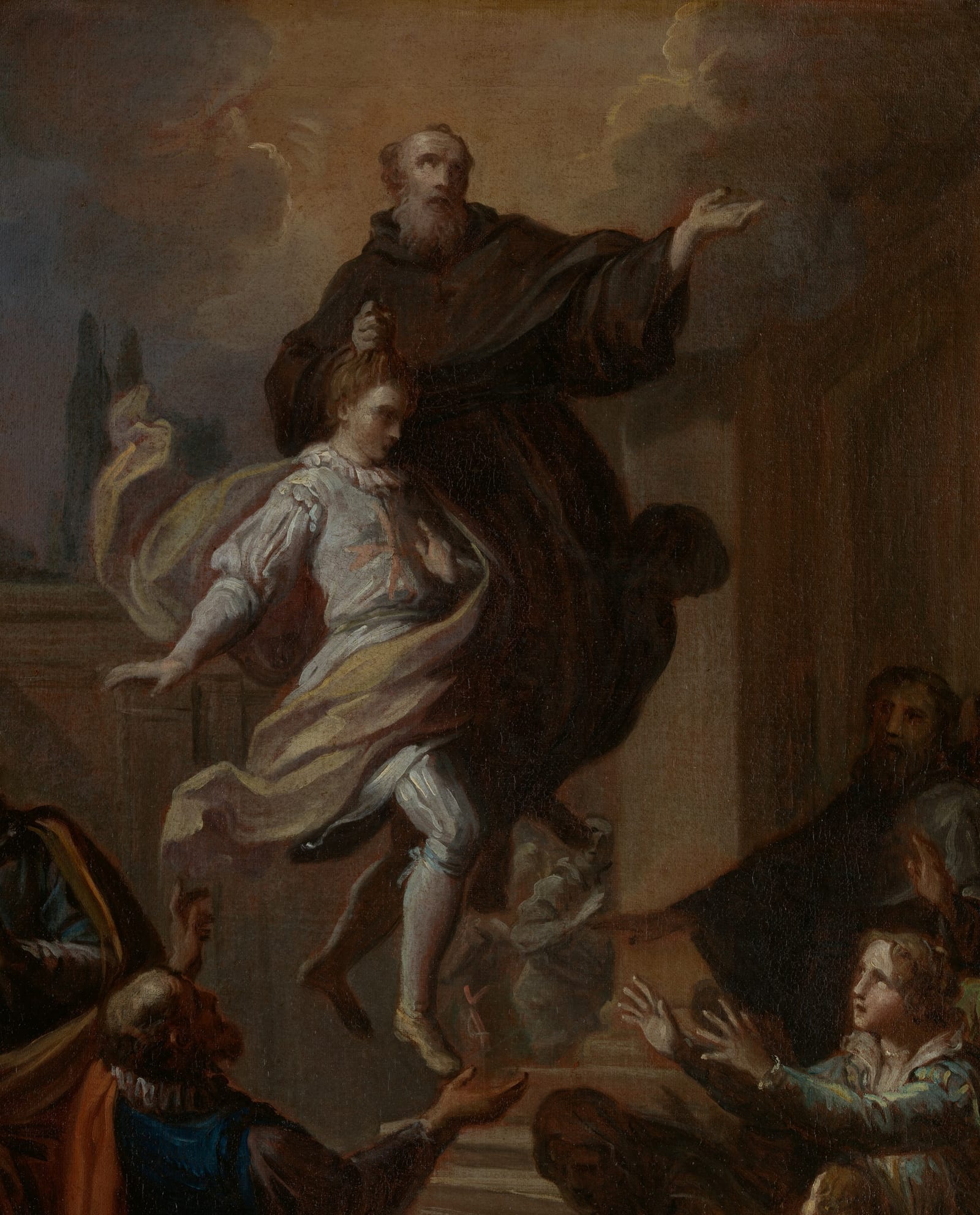
Giuseppe Maria Desa was born in a stable in Cupertino, in the Apulian heel of Italy — his father had fled creditors. He was a sickly, scrupulous, daydreaming child his neighbours called 'Bocca aperta' — 'the open-mouthed one' — because he so often stood gazing into the air. School defeated him.
Two Franciscan orders refused him. He was eventually accepted by the Conventuals as a stable-boy, but his patient holiness so disarmed them that they sent him to study for the priesthood. By a famous chance, the only Latin passage he had mastered was the one assigned in his oral examination, and he was ordained in 1628.
From that ordination Mass forward, ecstasies and levitations began. They became so frequent and so disruptive — he would rise from the ground at a chance word about the love of God — that Church authorities moved him from friary to friary to manage the crowds. He spent the last years of his life in increasing seclusion at Osimo, in the Marche. He died in 1663.
He was canonised in 1767 by Clement XIII. The records of his canonisation contain the testimony of dozens of eyewitnesses — bishops, nobles, surgeons, Pope Urban VIII himself, and the Lutheran philosopher Gottfried Wilhelm Leibniz, who cited the phenomena. Joseph remains the most thoroughly attested case of human levitation in the historical record.