
MIRACULOUS MIRACLES™

Saint — Joseph the Hymnographer

St. Joseph the Hymnographer
c. 810 AD, Sicily (Sicilian-Greek Christian family) — April 3, 886 AD, Constantinople
Sicilian-Byzantine monk; canon-composer of the eastern-Catholic and Orthodox liturgy
Hagia Sophia, Constantinople — the cathedral where his liturgical hymns are still sung in the Byzantine-Catholic and Orthodox calendars, Turkey
Feast
April 3
Canonized
Pre-congregation; venerated jointly in the eastern-Catholic Byzantine-rite and Orthodox calendars
Life

Joseph the Hymnographer was born around 810 in Sicily to a Sicilian-Greek Christian family that fled the Aghlabid Saracen conquest of Sicily (begun 827) — settling in the Greek-speaking Peloponnese.

He entered monastic life at age 15 at the monastery of Solomon at Thessaloniki, and later at Constantinople. Drawn to the community of St. Gregory of Decapolis (a disciple of St. Theodore the Studite), he became Gregory's disciple and spiritual son.

Around 840, during the second iconoclast crisis, Gregory of Decapolis sent Joseph to Rome to seek papal support for the iconodule cause. En route, the ship was captured by Arab pirates and Joseph was sold into slavery on Crete, where he spent years in captivity before being miraculously freed and returning to Constantinople.

After the Triumph of Orthodoxy of 843 under Empress Theodora, Joseph founded a monastery in Constantinople near the church of St. John Chrysostom, where he served as skeuophylax (keeper of the sacred vessels) of the Hagia Sophia under Patriarchs Methodius I and Ignatius.

He is the author of approximately 1,000 surviving canon-hymns for the Byzantine liturgical calendar — making him the single most prolific hymnographer in the entire eastern-Catholic and Orthodox liturgical tradition. His canons are chanted in the continuous liturgical use of the entire Byzantine-rite world to the present day. He died at Constantinople on April 3, 886.

Miracles & Phenomena
  • The 1,000-canon hymnographic legacy

    Joseph the Hymnographer's composition of approximately 1,000 surviving canon-hymns for the Byzantine liturgical calendar — covering the entire annual cycle of saints' feasts and seasonal observances — is the single largest hymnographic corpus in the entire history of Christian liturgy. The continuous liturgical transmission of his hymns from the 9th-century Constantinople through the entire Byzantine-rite Catholic and Orthodox world to the present day is among the most concrete and continuous liturgical transmissions in Christian history.

  • The miraculous deliverance from Cretan captivity

    Joseph's liberation from Arab-Cretan slavery (c. 843) — reported in his Vita as miraculous deliverance through the intercession of St. Nicholas of Myra — inspired his composition of multiple canons in honour of St. Nicholas, which are sung in the eastern-Catholic and Orthodox calendars on the feast of St. Nicholas (December 6) to the present day.

Relics
  • Body
    Relics of St. Joseph the Hymnographer
    Constantinople — the monastery he founded near the church of St. John Chrysostom; after the 1453 Ottoman conquest, fragmentary relics were translated to the Ecumenical Patriarchate (Phanar, Istanbul) and to Mount Athos, where they are venerated to the present day

    His principal relics rest today at the Ecumenical Patriarchate cathedral of St. George at the Phanar in Istanbul and at Mount Athos — the hymnographic legacy is, however, the principal continuing 'relic' in the continuous liturgical use of the entire Byzantine-rite world.

Iconography
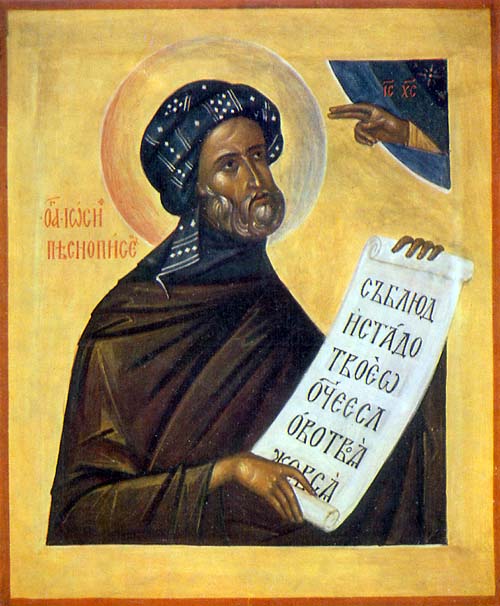
  • Joseph composing the canons

    The mid-9th-century Sicilian-Greek monk-hymnographer in Byzantine monastic habit at the scriptorium of the Hagia Sophia, quill in hand, the canon-hymn unfolding on the parchment, the Byzantine liturgical books visible behind — the iconography of eastern-Catholic Byzantine hymnographic tradition.

Patronages
Catholic and Orthodox Byzantine liturgical hymnographyCatholic Sicilian-Greek Christian traditionCatholic and Orthodox refugees of war