
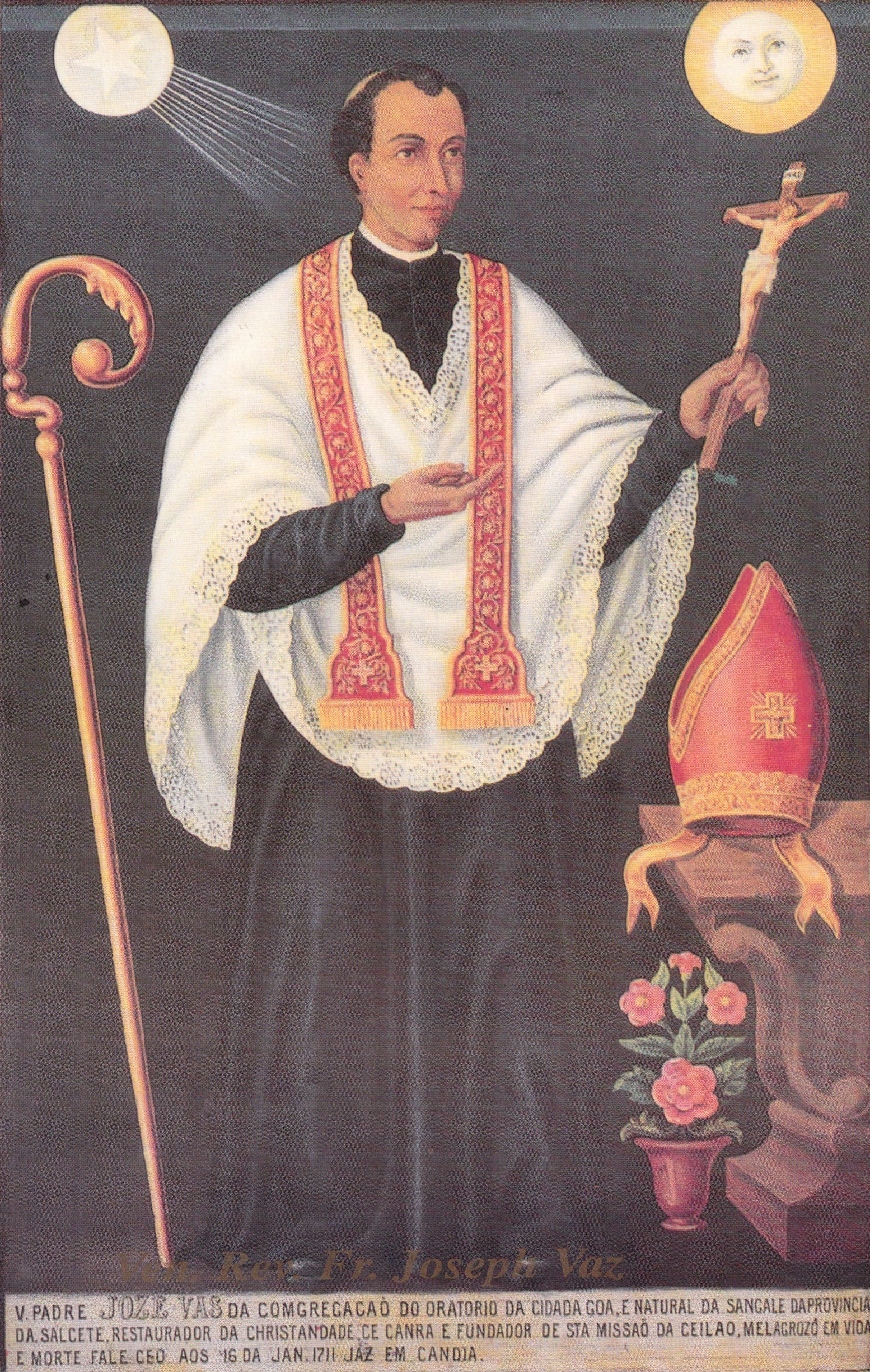
José Vaz was a Goan Konkani Brahmin Catholic, ordained priest at Goa in 1676, who responded to the catastrophic situation of Catholicism in Dutch-ruled Ceylon — where Calvinist authorities had since 1658 driven all Catholic priests out of the colony and were imposing the death penalty on any Catholic priest discovered there. By 1685 the Sri Lankan Catholic community — which had been the legacy of two centuries of Portuguese missions — was without priests and slowly disintegrating.
Vaz volunteered in 1686 to enter Dutch Ceylon clandestinely as a missionary. He travelled disguised as a poor coolie, taking the local Tamil dress and begging through the Tamil regions for over a year before reaching the Catholic communities. When he eventually established himself at Kandy (the still-independent Sinhalese kingdom in the central highlands), he learned Sinhala fluently, translated the catechism into Sinhala, composed Catholic devotional literature in both Tamil and Sinhala, and revived the spiritual life of the Sri Lankan Catholic communities.
He worked under continual threat from the Dutch authorities for twenty-five years. He founded the Goan Oratorian congregation specifically to send a succession of Indian (mostly Goan and Konkani-speaking) priests to support the Sri Lankan mission — a system that kept Catholicism alive on the island through the entire Dutch period until British takeover in 1796 and the eventual return of religious liberty. He died at Kandy on January 16, 1711, having held the see in pectore as Vicar Apostolic since 1696. Canonized by Pope Francis at Colombo on January 14, 2015 — the first canonization ever held in Sri Lanka and the first Sinhalese saint.