
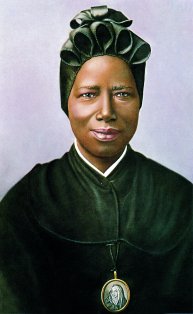
Bakhita — her original Darfuri name is unrecorded; 'Bakhita' meaning 'lucky' was given by her Arab kidnappers and remained her self-chosen name through life — was born around 1869 to a free Daju Sudanese family in Olgossa, Darfur. At seven (the date is approximate) she was abducted by Arab slave-traders during a raid on her village and sold across the Sahara in successive transactions over the next decade — first to a Sudanese chief at El Obeid, then to a Turkish military officer, then to the Italian consul at Khartoum (Callisto Legnani), and finally to the Italian Catholic merchant family of Augusto Michieli in Suakin, who brought her back to Italy in 1885.
In 1888 the Michieli family entrusted Bakhita to the Canossian Daughters of Charity of Venice (see Magdalena di Canossa, the foundress, in the 19th-c. entries) for child-minding while they were briefly back in Sudan. During the months at the Canossian house Bakhita was catechized for the first time, received baptism (taking the names Josephine Margaret Fortunata, her standard Italian Catholic name) and Confirmation at Venice on January 9, 1890, made her First Communion the same day at the hands of the Patriarch Giuseppe Sarto (the future Pope Pius X), and over the following months declined firmly the Michieli family's effort to remove her from the convent.
An Italian Royal court ruling of November 29, 1889 (in advance of the baptism) declared that slavery had no legal standing in Italy and she was therefore legally free — the principal Italian judicial precedent for the rejection of foreign slave-statuses. She entered the Canossian novitiate at the Canossian house of Schio in Vicenza Province in 1893 and made perpetual religious vows in 1896. She served at the Schio convent — as cook, doorkeeper, sacristan, and ultimately as 'Madre Moretta' (Little Black Mother), the affectionate name given her by Schio townspeople — for the remaining fifty years of her life. She died at Schio on February 8, 1947 at seventy-eight. Canonized 2000 by John Paul II — the principal modern Catholic saint of African origin and (since 2015 by Francis's declaration) the universal patron of victims of human trafficking.