
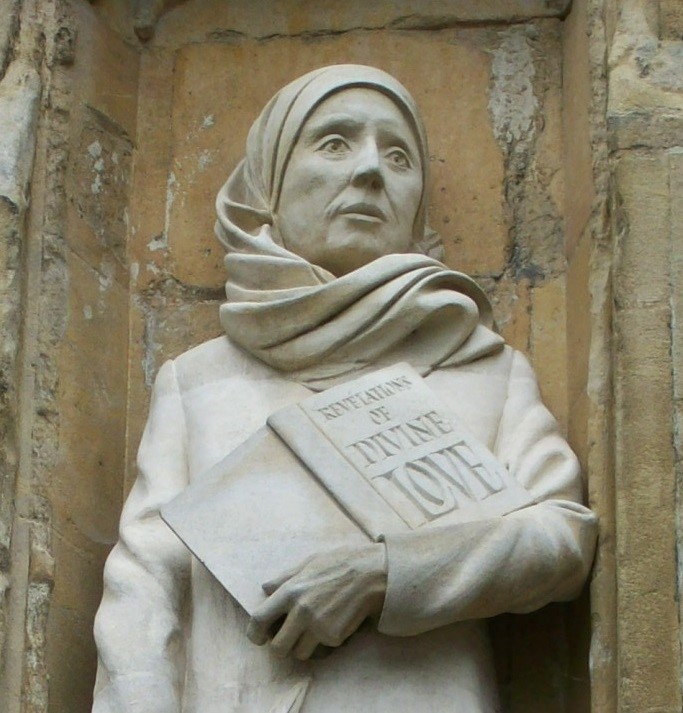
Julian was born around 1342 in England — her actual birthplace and birth-name unknown, the name 'Julian' being derived from the St. Julian's Church in Norwich to which she was attached as an anchoress.
On May 8 (or 13), 1373 — at the age of 30 — Julian received a series of sixteen mystical-visionary experiences ('showings' or 'revelations') during a grave illness at which she was believed to be dying. The visions concerned the Passion of Christ, the Trinity, the Incarnation, and the divine love — forming the content of her literary composition.
After her recovery, Julian undertook the English anchoress vocation — being walled-up in a small cell attached to the outer wall of the St. Julian's Church in Norwich, where she spent the 40+ years of her life (from around 1373 to her death around 1416).
Julian composed two versions of her Revelations of Divine Love (Middle English Sixteen Revelations of Divine Love):
1. Short Text — composed shortly after her 1373 vision, a shorter direct account of the visions.
2. Long Text — composed over the 20+ years of anchoress-meditation on the visions, a fuller theological-mystical elaboration.
The Revelations of Divine Love is recognized as the first known book written in the English language by a woman — institutionally establishing Julian as one of the principal figures in the history of English literature.
Julian's theological-mystical contribution — her famous articulation of the maternal-nurturing character of Christ ('Christ our Mother'), the optimistic-universalist teaching summarized in the famous formula 'All shall be well, and all shall be well, and all manner of thing shall be well' (revealing itself through the 'hazelnut vision' of the divine love encompassing the entire cosmos), and the Trinitarian love-mystical theology — establishes the late-medieval English women's-mystical theological tradition.
She received the spiritual-friendship visit of Bl. Margery Kempe in 1413 — the documented meeting of the two principal late-medieval English women mystics.
Julian died at Norwich around 1416.