
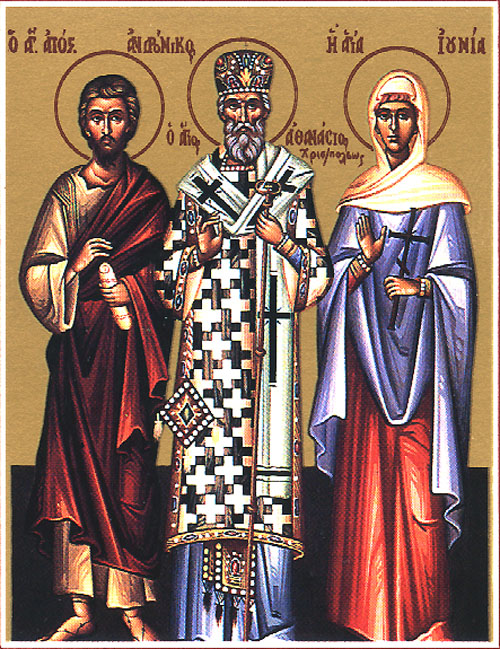
Junia and Andronicus are greeted together by Paul in Romans 16:7 with the celebrated phrase: 'Salute Andronicus and Junia, my kinsmen and my fellow prisoners, who are of note among the apostles, who also were in Christ before me.' The four claims Paul makes about them are extraordinary: they were his 'kinsmen' (suggenes — either Jewish kinsmen by descent or, possibly, blood relatives); his 'fellow prisoners' (so they had been imprisoned with Paul at some point during his missionary career, of which we have no other record); 'of note among the apostles' (the Greek episēmoi en tois apostolois has been read for two thousand years as the explicit Pauline identification of them as apostles in the broad sense); and 'in Christ before me' (so they were among the very earliest Christians, predating Paul's own conversion in c. AD 34).
The grammatical-historical question of whether the second name in the pair should be read as the feminine Junia (the standard reading of the early Greek Fathers including John Chrysostom, who explicitly comments on her status as a woman apostle) or as the masculine Junias (a reading that became dominant only in the medieval Latin tradition through textual variants that have since been corrected by modern critical scholarship) is now resolved in favour of the feminine Junia by virtually all major 20th- and 21st-century critical New Testament editions (Nestle-Aland, UBS). The episēmoi en tois apostolois construction is generally read as 'well-known among the apostles' (i.e., they are themselves apostles) rather than 'well-known to the apostles' (which would mean they are not).
Junia is therefore one of the very few New Testament figures explicitly identified as a woman apostle (in the broad sense — that is, missionary witness of the resurrected Christ, sent on apostolic mission; not one of the Twelve). The Byzantine tradition identifies Andronicus as one of the Seventy and as the first Bishop of Sirmium in Pannonia (modern Sremska Mitrovica, Serbia). The couple are venerated jointly in the Byzantine calendar on May 17.