
MIRACULOUS MIRACLES™

Saint — Junípero Serra

St. Junípero Serra
November 24, 1713 — August 28, 1784
Apostle of California — Founder of the California Missions
Mission San Carlos Borromeo (Carmel Mission), United States
Feast
July 1
Canonized
September 23, 2015 (by Pope Francis — first canonization on US soil, at the Basilica of the National Shrine, Washington DC)
Beatified
September 25, 1988 (by John Paul II)
Life

Miquel Josep Serra was born in a stone farmhouse in Petra, Majorca, the son of poor farmers. He took the name Junípero — after one of Francis of Assisi's first companions — when he entered the Franciscans at seventeen. By thirty he was a professor of philosophy with a doctorate in theology; he could have remained an honored academic in Spain for the rest of his life.

In 1749, aged thirty-five, he volunteered for the New World missions and crossed to Mexico. On the walk inland from Veracruz to Mexico City an insect bite became infected; the leg ulcer never healed and gave him pain for the rest of his life. He spent eighteen years among the Pamé people in the Sierra Gorda before being sent north into Alta California.

Between 1769 and his death in 1784 he founded nine of California's twenty-one Spanish missions: San Diego, San Carlos (Carmel), San Antonio, San Gabriel, San Luis Obispo, San Juan Capistrano, San Francisco de Asís (Dolores), Santa Clara, and San Buenaventura. He walked thousands of miles on his ulcerated leg, baptized perhaps six thousand Indigenous Californians, and confirmed five thousand more under a special apostolic faculty granted because no bishop yet existed in California.

His missions, and the system he founded, are today the subject of intense and legitimate historical debate over their consequences for Indigenous Californian peoples — disease, forced labor, and cultural disruption among them. The Church's case for his sanctity rests on his personal holiness, his repeated written defense of Indigenous people against Spanish soldiers and colonial governors (his 1773 Representación to the Viceroy is a foundational document of Indigenous-rights advocacy in the Americas), and the witness of contemporaries who knew him as a man of penance, prayer, and personal poverty.

Miracles & Phenomena
  • The Cure of Sr. Mary Boniface Dyrda (canonization miracle)

    December 1960

    A Franciscan sister of Lemont, Illinois, was diagnosed in 1960 with terminal lupus and given days to live. After her community began a novena to Serra she experienced an immediate and complete remission, lived another fifty years, and died in 2012 at age 87. The healing was recognized by the Vatican in 1987 and led to Serra's 1988 beatification.

  • Survival on the road from Veracruz

    1749

    Walking with a single companion from Veracruz to Mexico City in 1749, Serra was bitten by a snake or scorpion (the chroniclers differ); his leg swelled, festered, and never healed. He continued the journey on foot, refusing a mount. The persistent wound — which should have killed him in the tropics — became the lifelong mark by which Indigenous Californians knew him; many of his miraculous healings of others were associated with prayer at his ulcerated leg.

Relics
  • Body
    Tomb of Junípero Serra
    Sanctuary of Mission San Carlos Borromeo, Carmel-by-the-Sea, California

    His remains rest in a sarcophagus before the altar of the Carmel Mission, the mission he loved best and from which he administered the others. A bronze recumbent figure by Jo Mora caps the tomb.

Iconography
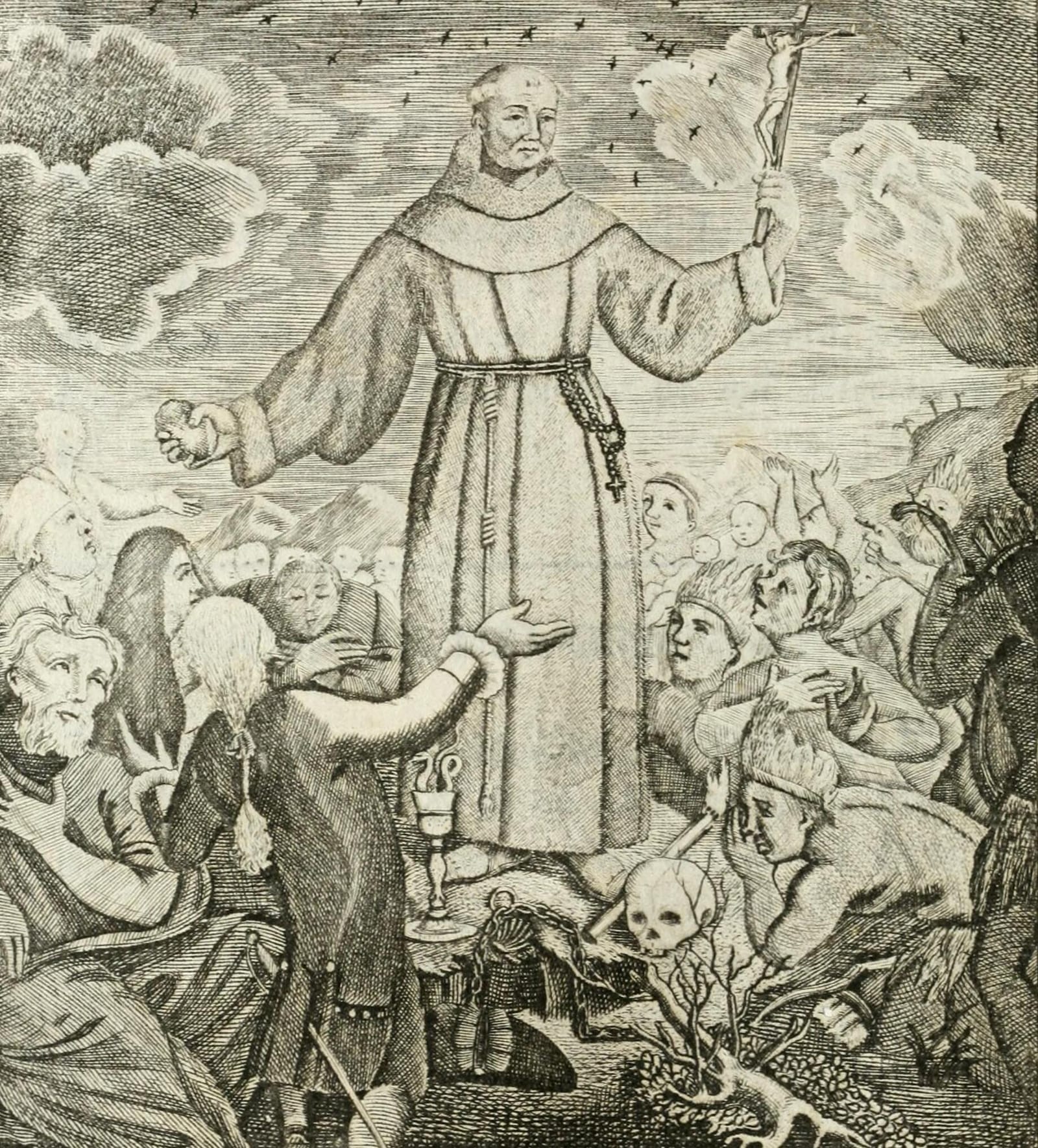
  • Serra with the Cross and a Mission Child

    Standard depictions show him in grey Franciscan habit, holding a crucifix raised in his right hand and an Indigenous Californian child or convert at his side. He is usually shown limping or with a staff because of his leg wound.

Patronages
Hispanic AmericansVocationsCalifornia (state)
Sources & Further Reading