
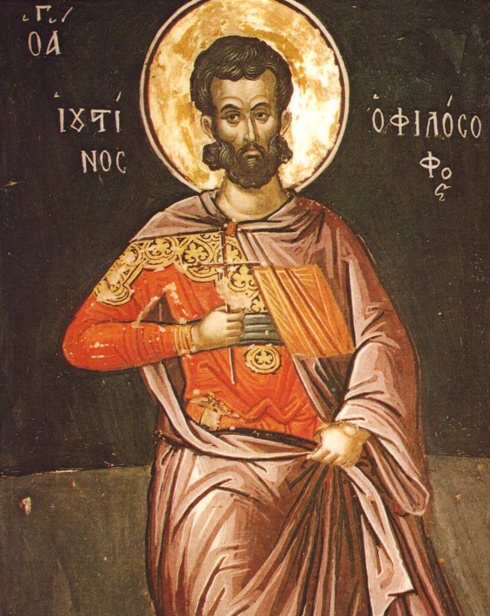
Justin was born in Samaria to Greek parents and trained in Stoic, Pythagorean, and Platonist philosophy in turn, finding none satisfying. Walking along the seashore one day he met an old man who pointed him to the Hebrew prophets and to Christ. He was converted and remained ever after, in his own words, 'a Christian philosopher,' wearing the philosopher's cloak.
He taught publicly in Rome, where he composed two Apologies (to the Emperor Antoninus Pius and to the Senate, c. 155) and the Dialogue with Trypho — a Jewish interlocutor — which are among the earliest non-canonical Christian writings to survive. His First Apology contains the oldest detailed eyewitness description of the Christian Eucharist, fundamental to liturgical scholarship.
Denounced by a pagan rival philosopher, Justin and six companions were brought before the Roman prefect Junius Rusticus. The record of their trial — the Acta Iustini — is one of the earliest surviving martyr-acts. Refusing to sacrifice, they were beheaded c. 165. Justin is the first thinker to argue that the Logos (Word) of John's Gospel had sown 'seeds of truth' in pagan philosophy fulfilled in Christ.