
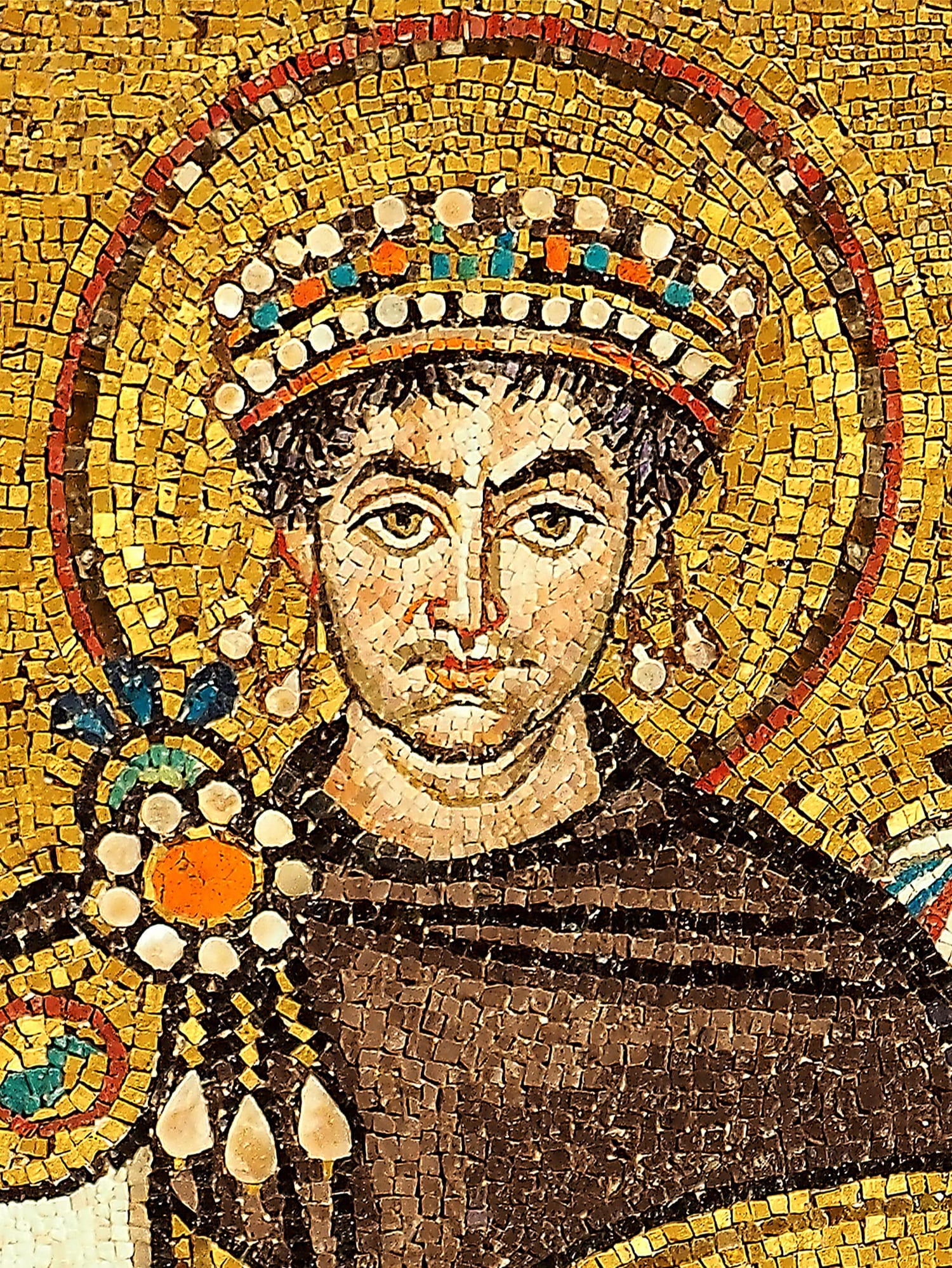
Justinian I (Latin Iustinianus, Greek Ioustinianos) was — per the contemporary biographer Procopius of Caesarea — born at the small village of Tauresium in the Latin-speaking Roman province of Dardania (in the central Balkans, in what is now the southern Republic of North Macedonia) on May 11, 482 AD, to a Latin-speaking Illyrian peasant family. His uncle Justin — a former peasant who had risen through the Roman military to become commander of the imperial guard — was acclaimed Eastern Roman Emperor in 518 as Justin I. Justin had no children; he adopted his nephew Petrus Sabbatius Iustinianus as his successor and trained him in the imperial administration through the 520s.
Justinian succeeded his uncle on August 1, 527, and reigned as Eastern Roman Emperor for 38 years until his death on November 14, 565 — one of the longest reigns of the entire Roman imperial tradition. His reign is for Western and Catholic civilization in three principal areas.
First, the Corpus Juris Civilis: the systematic codification of the entire Roman legal tradition under Justinian's direction by the great Latin jurist Tribonian and his team. The work — comprising the Codex Iustinianus (the imperial-constitutional code, 534), the Digest (the Roman juristic-doctrinal compilation, 533), the Institutes (the Roman legal textbook, 533), and the Novels (the post-codification imperial legislation, 534–565) — is the document of all Western and Catholic legal tradition. The medieval rediscovery of the Digest at the University of Bologna in the 1070s was the moment of the medieval Western university tradition; the Corpus Juris Civilis remains the document of all civil-law-tradition legal systems worldwide.
Second, the architectural patronage: Justinian directed the substantial Constantinopolitan rebuilding after the catastrophic Nika riots of January 532, in which he and his consort Empress Theodora had been on the verge of fleeing the capital and were dissuaded by Theodora's famous speech ('royal purple is the noblest shroud'). The architectural rebuilding produced the great Hagia Sophia (the 'Holy Wisdom' cathedral) of 532–537 — designed by the Greek mathematicians Anthemius of Tralles and Isidore of Miletus, one of the supreme architectural-engineering achievements of human civilization and the Eastern Orthodox cathedral. Hagia Sophia remained the largest Christian cathedral in the world for nearly a thousand years until the completion of the present St. Peter's Basilica in 1626.
Third, the Reconquista of the Western Roman Empire: under his great generals Belisarius and Narses, Justinian recovered for the Eastern Empire the territories of North Africa (533–534, the Vandalic War), Italy (535–554, the catastrophic Gothic War), and southern Spain (552). The reconquista was substantially completed at enormous human cost (the great Plague of 541–549 alongside the long Gothic War devastated Italy and the Eastern Empire); much of the Italian and African reconquest was substantially lost again during the late 6th and 7th centuries.
Justinian's ecclesiastical policy was the principal source of Catholic-tradition reserve about his sanctity. His attempt to reconcile the Chalcedonian and Monophysite traditions through the Three Chapters condemnation (553, the Fifth Ecumenical Council of Constantinople II) produced the substantial Three Chapters Schism in the Western Catholic Church (see Pope Vigilius's entry above). Despite this complication, Justinian is venerated as Saint Justinian in the Byzantine-Orthodox tradition and is recognized in the Roman Martyrology.