
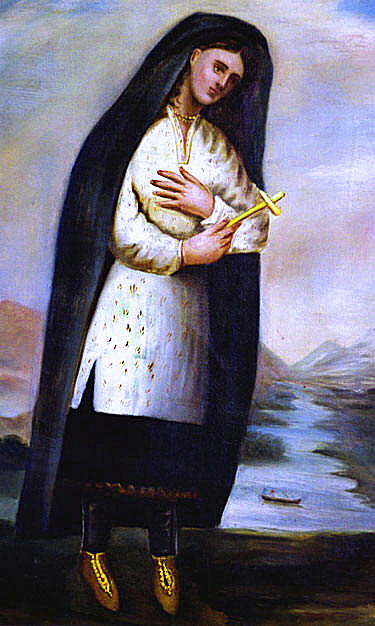
Tekakwitha — 'she who bumps into things' — was born in 1656 at Ossernenon, a Mohawk village on the Mohawk River in what is now upstate New York. Her father was a Mohawk chief; her mother was an Algonquin captive who had been baptised before her captivity. Both parents and a younger brother died in the smallpox epidemic of 1660, when Kateri was four. The disease scarred her face and weakened her eyesight for the rest of her short life.
She was raised by an uncle who became chief and hated Christianity. At eighteen, after meeting Jesuit missionaries who passed through the village, she asked for instruction. Baptised by Fr. Jacques de Lamberville on Easter 1676 with the name Catherine (Kateri in Mohawk), she immediately faced relentless persecution: stones thrown at her, food withheld on Sundays, threats of marriage by force.
In 1677 she fled, with two companions, more than two hundred miles north through the forest to the Jesuit mission at Kahnawake on the St. Lawrence south of Montreal — a community of Indigenous Christian converts. There she lived with extraordinary intensity: severe fasts, mortifications, hours of prayer, work for the sick. She made a vow of perpetual virginity — almost unheard of among Indigenous women of her time — and was admitted to weekly Communion, a rare privilege.
She died on Wednesday of Holy Week, 1680, aged twenty-four. Witnesses — including the Jesuit Pierre Cholenec — reported that within minutes of her death the smallpox scars vanished from her face and her features became radiantly clear. She was canonised by Benedict XVI in 2012, the first Indigenous person of North America so honoured.