
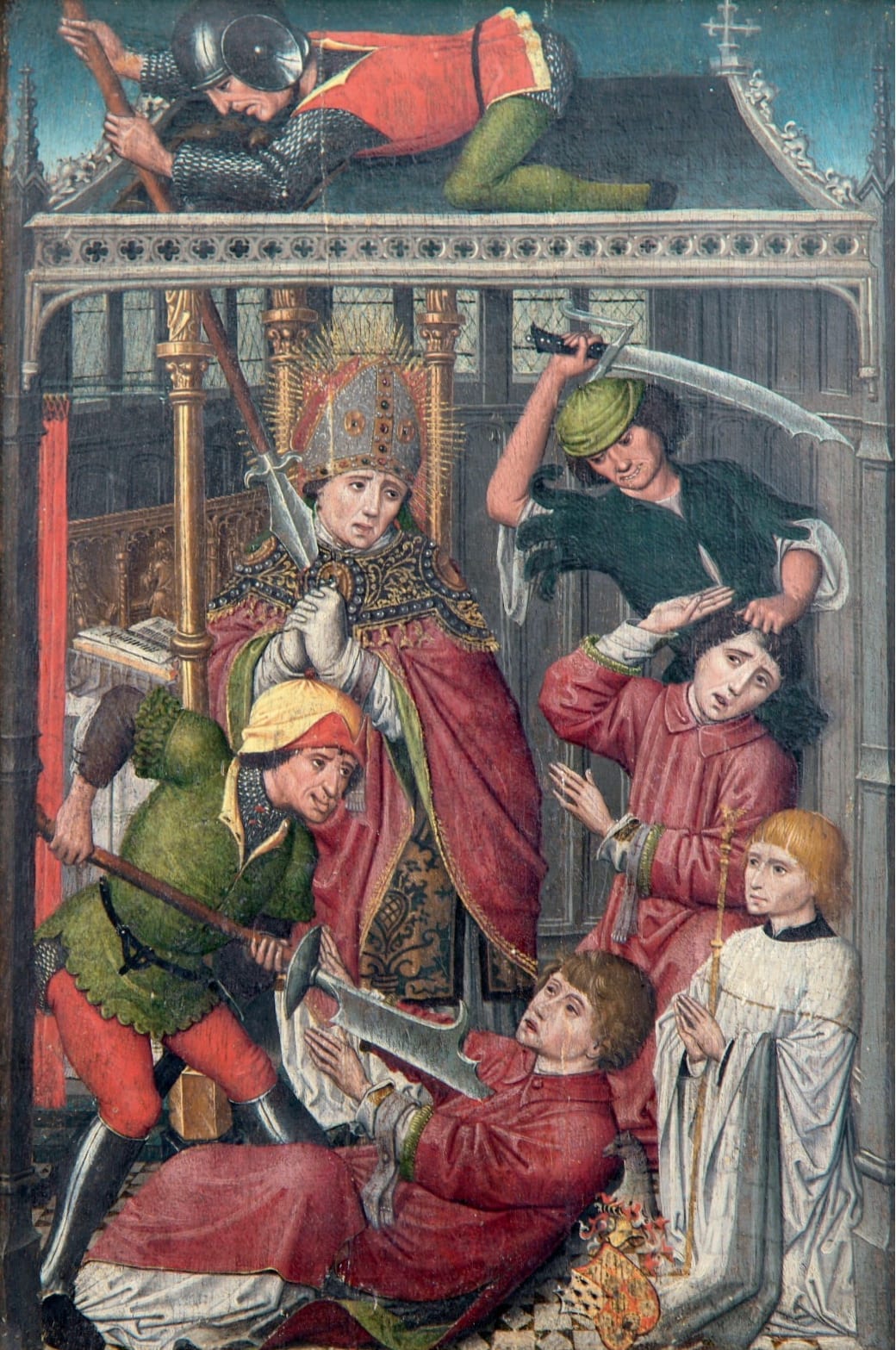
Lambert was born to a noble family of Maastricht and educated by his uncle, the bishop Theodard, whom he succeeded as bishop around 670. After a court coup he was driven from his see in 675 and spent seven years as a monk at the abbey of Stavelot before being restored to Maastricht in 682.
He led the missionary evangelization of the still partly pagan Toxandrian region (modern southern Netherlands and northern Belgium) with great vigor. He was killed at his villa at Liège around 705 — by the most widespread tradition, in revenge for his rebuke of the affair of Pepin of Herstal (the Carolingian mayor of the palace) with his concubine Alpaida — by Dodo, an official of Pepin's court.
His relics were translated by his successor Hubert from Maastricht to Liège, transforming the small villa where he died into the principal city of the new diocese of Liège. The Cathedral of Saint Lambert at Liège, built over his tomb, was for nearly a thousand years one of the greatest churches of the Low Countries; it was demolished in 1794 during the French Revolution.