
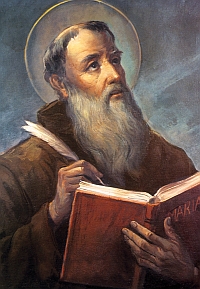
Caesare de Rossi was born at the southern Italian port of Brindisi, lost his father at seven, and was sent to Venice to be educated by his uncle. He joined the Capuchin reform of the Franciscans at sixteen, taking the name Lorenzo. He proved extraordinarily gifted in languages — reading Hebrew, Greek, Latin, German, French, Spanish, Czech, and his native Italian fluently enough to dispute in each.
Sent on Capuchin missions across the courts of Counter-Reformation Europe, he served as papal legate to the German emperor, to the kings of Spain, France, and Bavaria, and to the Vienna of Rudolf II. In 1601 he commanded — only in the moral sense, but with crucifix in hand at the head of the Christian army — the Battle of Stuhlweissenburg (modern Székesfehérvár) against the Ottoman invasion of Hungary, and was credited by the Imperial generals with the unexpected victory.
He served as Vicar-General of the Capuchins (1602–1605) and refused all higher office. His preserved writings — about fifteen folio volumes, including the great Mariale on Marian theology and a vast set of biblical commentaries with Hebrew exegesis — were rediscovered and published in the 19th and 20th centuries; John XXIII declared him a Doctor in 1959.