
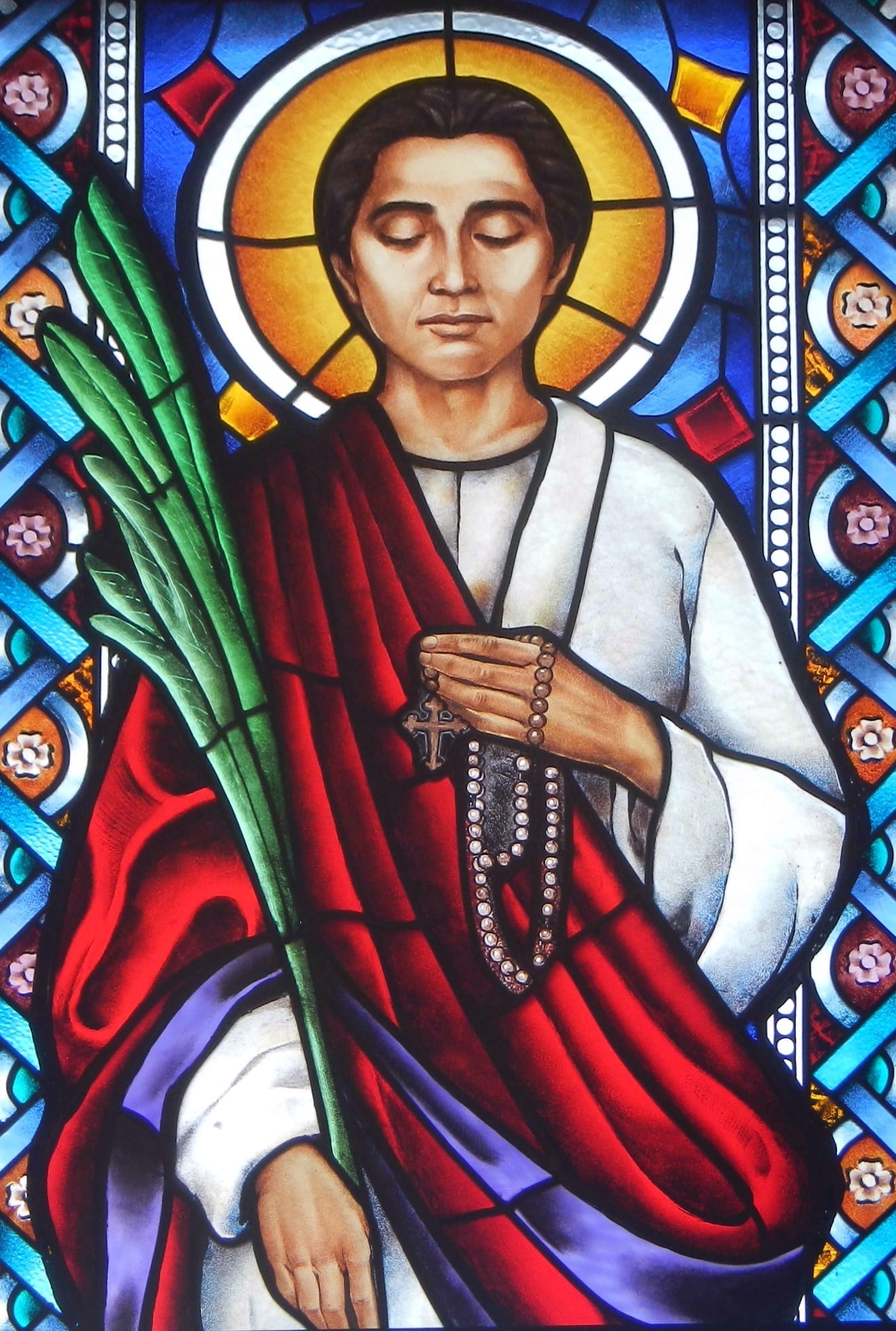
Lorenzo Ruiz was born in the Binondo district of Manila to a Chinese father (Mariano Ruiz Cantonis) and a Tagalog mother (Mariana de Jesús), both Catholic. He was educated by the Dominicans of Binondo, served as altar boy and parish notary, and became a calligrapher for the Dominican parish records. He married Rosario, a Tagalog woman, around 1622, and the couple had three children.
In 1636, falsely accused of homicide (the precise circumstances remain disputed — some sources hold the homicide an accident, some hold the accusation pure invention), Lorenzo took ship from Manila aboard a Dominican-organized vessel bound (he believed) for Formosa. The ship was actually carrying four Dominican missionaries — Antonio González, Guillermo Courtet, Miguel de Aozaraza, Vicente Shiwozuka — and a lay brother (Lazaro of Kyoto) on a clandestine mission to Tokugawa Japan, where Christianity had been savagely outlawed since the Shimabara persecutions of the 1620s.
Arrested at Okinawa on July 10, 1636 and brought to Nagasaki, the six were tortured for fourteen months at Nishizaka Hill — the standard regime of the Tokugawa anti-Christian inquisition: water torture, the 'tsurushi' suspension (hung head-down in a pit of excrement and rats with a small cut in the temple to drain blood slowly), and bamboo splinters under the fingernails. All six refused to apostatize. On September 27–29, 1637, they were executed by tsurushi at Nishizaka Hill — the same hill where the 26 Martyrs of Japan (Paul Miki and Companions) had died in 1597. Lorenzo Ruiz lived for three days suspended in the pit before dying. His final recorded words, addressed to the interpreter who offered him release if he would renounce his faith: 'I am a Catholic, and wholeheartedly I will die for God. Had I a thousand lives, all these to him shall I offer.' Beatified at Manila in 1981 (the first beatification ever held outside Rome). Canonized 1987 — the first Filipino canonized saint.