
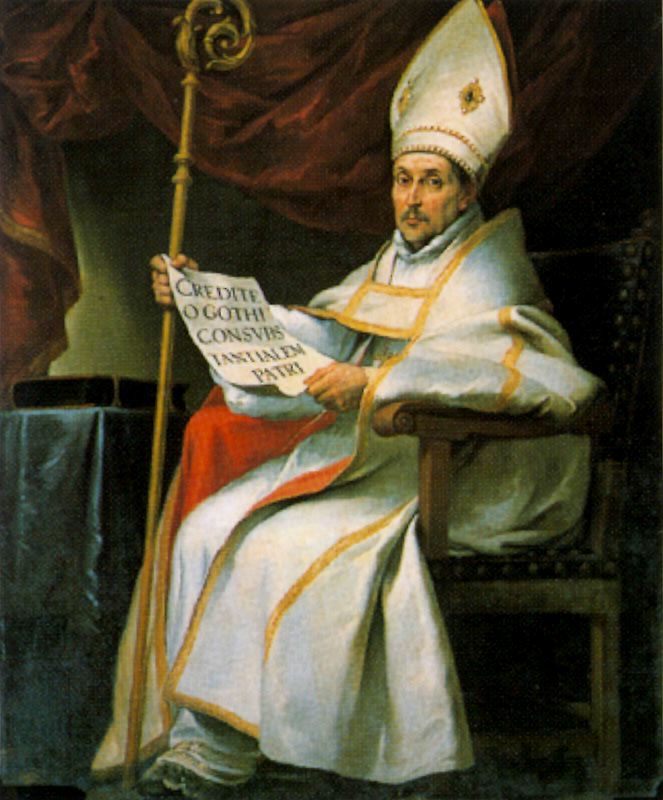
Leander (Latin Leander) was the eldest brother of one of the most extraordinary saintly families in Christian history: he and his three siblings — Isidore (see Isidore's entry already in the catalogue), Fulgentius (Bishop of Écija), and their sister Florentina (foundress of a network of women's monasteries) — were all canonized. The family was a Byzantine-Hispano-Roman family of Cartagena that fled north to Visigothic Seville during the late 6th-century Byzantine-Visigothic conflicts over southeastern Hispania.
Leander entered religious life young and was consecrated Archbishop of Seville around 578. His foundational pastoral work was the personal catechesis of the future Visigothic King Reccared — the younger brother of St. Hermenegild (see Hermenegild's entry in the 6th-c. catalogue, whose martyrdom in 586 set the stage for Reccared's conversion). Through Leander's direct personal catechetical work with Reccared after Hermenegild's death, the entire Visigothic royal family was brought from Arian to Catholic Christianity. The foundational moment was the Third Council of Toledo of May 8, 589 — at which Reccared formally professed Catholic Christianity in the presence of seventy-two Visigothic bishops, and Leander preached the foundational sermon that publicly proclaimed the Visigothic Kingdom of Hispania a Catholic Christian state.
Leander corresponded extensively with his contemporary Pope Gregory I the Great (see Gregory's entry already in the catalogue) — the two had become personal friends when Leander was at Constantinople on a diplomatic mission in the early 580s, where Gregory was at the time serving as papal apocrisiarius. Gregory dedicated to Leander the long Latin commentary on the Book of Job (the foundational Moralia in Job, one of the most influential medieval Latin biblical-theological works), and the two great Catholic 6th-century theological figures sustained their friendship through letter for the rest of Leander's life.
He died at Seville around 601 AD and was succeeded by his much younger brother Isidore — who governed the Sevillian see for the next thirty-five years and became the foundational father of medieval Visigothic-Catholic Spain. Leander is the elder of the foundational Sevillian episcopal brother-pair.