
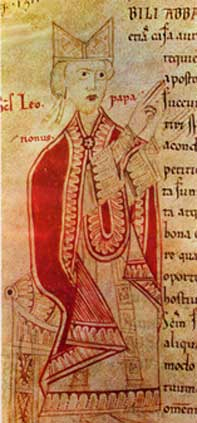
Bruno von Egisheim-Dagsburg was born in Alsace to a noble family related to the Salian emperors. Bishop of Toul at twenty-four, he ministered there for twenty years before, against his own protest, being acclaimed Pope at the Diet of Worms in 1048 by his cousin Emperor Henry III. Setting out for Rome on foot in pilgrim garb, he refused to take office until the Roman clergy and people had formally elected him — an early signal of the reform programme to come.
His six-year pontificate is the hinge between the deeply compromised papacy of the early eleventh century and the reformed papacy of Gregory VII and Urban II. He travelled relentlessly — Rome, Reims, Mainz — convoking reform synods that deposed simoniac bishops, condemned clerical marriage, and bound priests to celibacy as a Western discipline. He brought to Rome a circle of reformers including Hildebrand (the future Gregory VII), Humbert of Silva Candida, and Peter Damian.
His pontificate ended in tragedy. He led a papal army personally against the Normans of southern Italy and was defeated and captured at the Battle of Civitate (1053). Released after nine months, he returned to Rome a broken man. In July 1054, three months after his death, his legates in Constantinople — led by Cardinal Humbert — placed a bull of excommunication on the altar of Hagia Sophia, formally beginning the Great Schism between Rome and the East.