
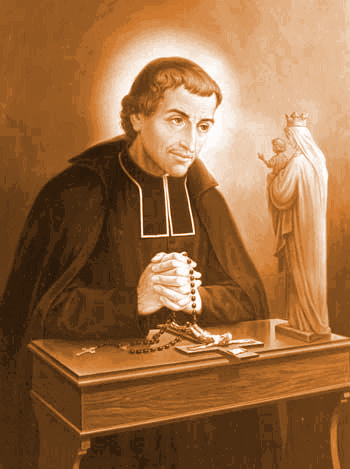
Louis-Marie Grignion was born at Montfort-sur-Meu in upper Brittany, educated by the Jesuits at Rennes, and was ordained priest at Paris in 1700 at twenty-seven. After a few unsuccessful pastoral assignments (his fierce austerity and intransigent Catholic Counter-Reformation positions made him difficult for his French Sulpician superiors), he travelled to Rome in 1706 to ask Pope Clement XI's specific commission. The pope, after a long conversation, gave him the title 'Apostolic Missionary' and instructed him to preach throughout France — a status outside the normal diocesan structures.
From 1706 to 1716 he travelled western France — Brittany, Normandy, Anjou, Poitou, Saintonge, Vendée — as a wandering preacher. He preached over two hundred parish missions across the decade. His distinctive teaching was the radical Marian consecration ('total consecration of self to Jesus through Mary,' culminating in the formula of holy slavery — Per Mariam ad Jesum), which he expounded in The Secret of Mary, the long True Devotion to the Blessed Virgin (which was lost in a chest after his death and rediscovered only in 1842, becoming one of the foundational Marian works of the modern Catholic Church), and the Méthode du Saint Rosaire.
He founded two religious congregations: the Daughters of Wisdom (1703, with Marie-Louise Trichet) for women's hospital and teaching work, and the Company of Mary (also called the Montfort Missionaries) for the continuation of his itinerant preaching ministry. He died in his mission tent at Saint-Laurent-sur-Sèvre on April 28, 1716. Canonized 1947. His True Devotion was the basis of John Paul II's papal motto Totus tuus ('Totally yours' — addressed to Mary), and through John Paul II Marian consecration entered the heart of late 20th-century Catholic devotional life globally.