
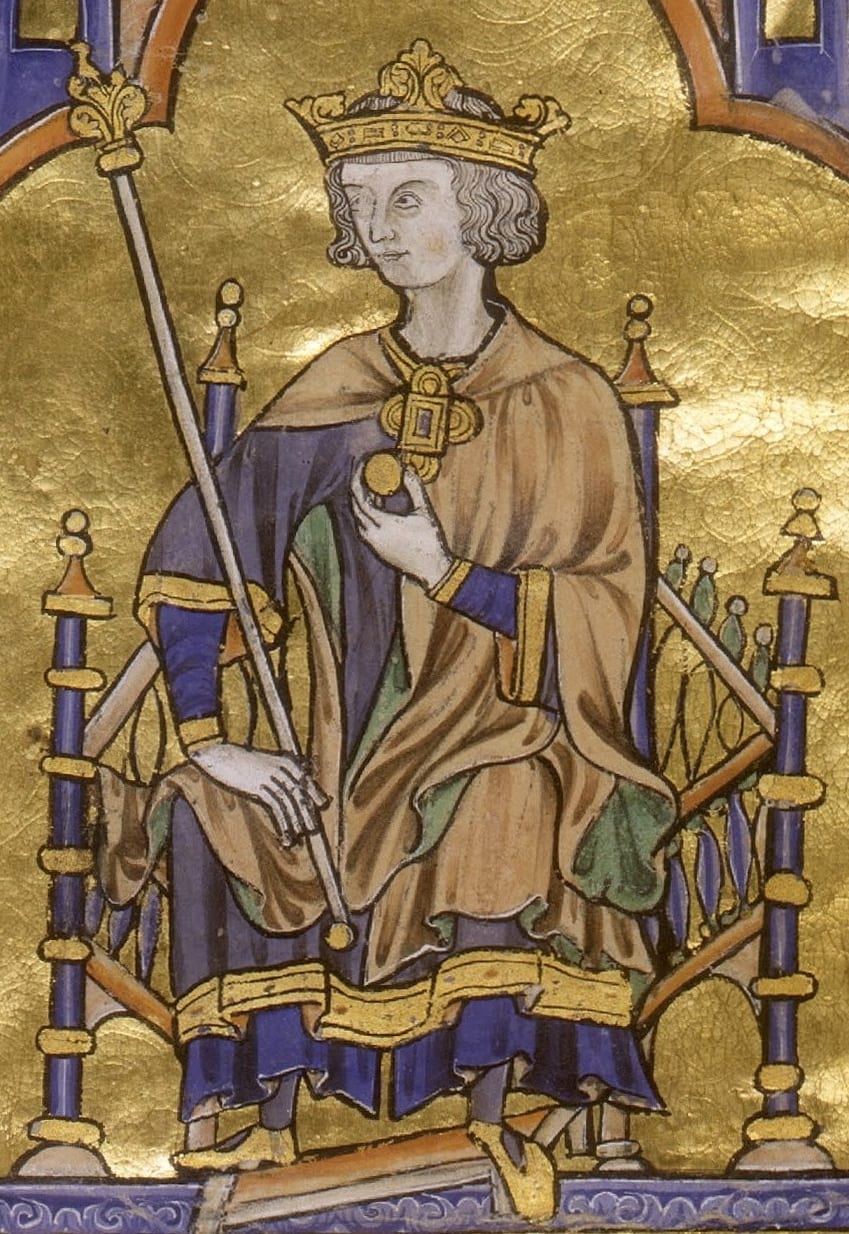
Louis became King of France at the age of twelve on his father Louis VIII's death in 1226, with his mother Blanche of Castile (St. Ferdinand III's first cousin) serving as regent until his majority. His forty-four-year reign was the high noon of medieval French Catholicism. He built the Sainte-Chapelle in Paris (1242–48) as the reliquary chapel for the Crown of Thorns and other Passion relics he purchased from the Latin Emperor of Constantinople — paying 135,000 livres tournois for the relics and 40,000 livres tournois for the chapel itself.
He led two crusades. The Seventh Crusade (1248–54) took him to Egypt, where he was defeated and captured at Mansourah in April 1250 — and only ransomed for an enormous sum. He spent four further years in the Holy Land, fortifying Acre, Caesarea, Jaffa, and Sidon. The Eighth Crusade (1270) aimed at Tunis; the army was devastated by dysentery, and Louis himself died on August 25, 1270 on a bed of ashes in his tent at Carthage, his last word a whispered Jerusalem. His body was boiled to separate flesh from bone — the standard mortuary practice for those who died on crusade — and the bones were carried home to Saint-Denis.
His sanctity was already legendary in his lifetime: daily Mass and the full Office, hair shirts, washing the feet of lepers, personally feeding the poor at his own table at Vincennes, and his celebrated practice of sitting under an oak to hear the grievances of his humblest subjects directly — the foundational image of French royal justice. He sponsored Aquinas at the Sorbonne. He was canonized in 1297 by Boniface VIII, the only French king ever canonized. He is the personification of the ideal medieval Catholic king, the central icon of French royal sanctity, and the patron of dozens of cities (most famously St. Louis, Missouri).