
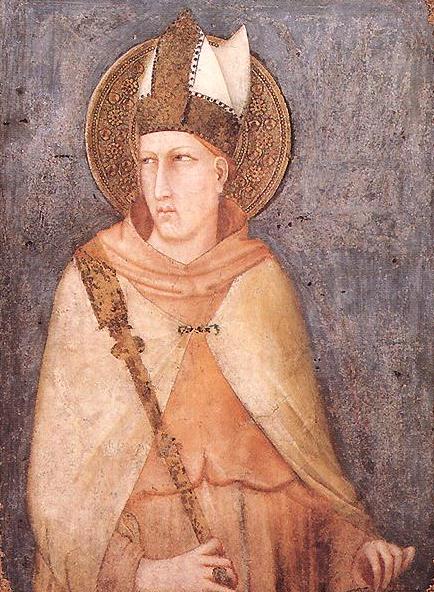
Louis of Anjou was born on February 9, 1274 at Nocera in the Kingdom of Naples — the second son of King Charles II of Naples (Charles the Lame) and Queen Maria of Hungary (Árpád princess, sister of St. Kinga and Bl. Yolanda).
Louis was the grand-nephew of St. Louis IX of France (1214–1270) and shared the royal French Catholic name; the grand-nephew of St. Elizabeth of Hungary (1207–1231) through his Árpád maternal lineage; and therefore related to virtually every medieval European royal-Catholic saint of the 13th century.
In 1288, at the age of 14, Louis and his two brothers (Robert and Raymond Berengar) were taken as hostages by the Aragonese court of King Alfonso III of Aragon — in the course of the Sicilian-Vespers War (the Aragonese-Angevin dynastic struggle over the Kingdom of Sicily). The three young princes spent the seven years (1288–1295) as hostages at the Aragonese court.
During the hostage period, Louis received his education from Franciscan chaplains — producing his Franciscan vocation. He undertook the Franciscan Third Order (Tertiary) vows during the hostage period.
In 1295, after the Treaty of Anagni ended the Sicilian-Vespers War, Louis was released. His elder brother Charles Martel of Anjou (future King of Hungary) had died in 1295 — making Louis the heir apparent to the Kingdom of Naples.
Louis refused the royal succession — declaring that he would undertake the Franciscan Order and the priestly life. In 1296 he formally renounced the Neapolitan royal succession in favour of his younger brother Robert (future King Robert the Wise of Naples 1309–1343) and entered the Franciscan Order.
Pope Boniface VIII appointed the young Louis (age 22) as Bishop of Toulouse in December 1296 — consecrated at Rome in January 1297. Louis undertook the new episcopal office in the strict Franciscan poverty — continuing to wear the patched Franciscan habit under the episcopal vestments and personally distributing his episcopal revenues to the poor.
His Toulouse episcopate lasted only seven months (January–August 1297) — Louis died at Brignoles in Provence on August 19, 1297 at the age of 23.
His canonization by Pope John XXII on April 7, 1317 — at the request of King Robert the Wise (Louis's younger brother, the beneficiary of Louis's succession-renunciation) — institutionally established the Louis-of-Toulouse cult.
The famous Simone Martini altarpiece ('Louis of Toulouse crowning his brother Robert of Naples', c. 1317, the commissioned canonization-celebration painting for King Robert of Naples) at the Museo di Capodimonte in Naples — one of the principal 14th-century Italian Gothic paintings — depicts Louis in Franciscan habit under the episcopal vestments crowning his royal brother Robert, establishing the Louis-of-Toulouse iconography of the Franciscan-royal-episcopal-succession-renunciation.