
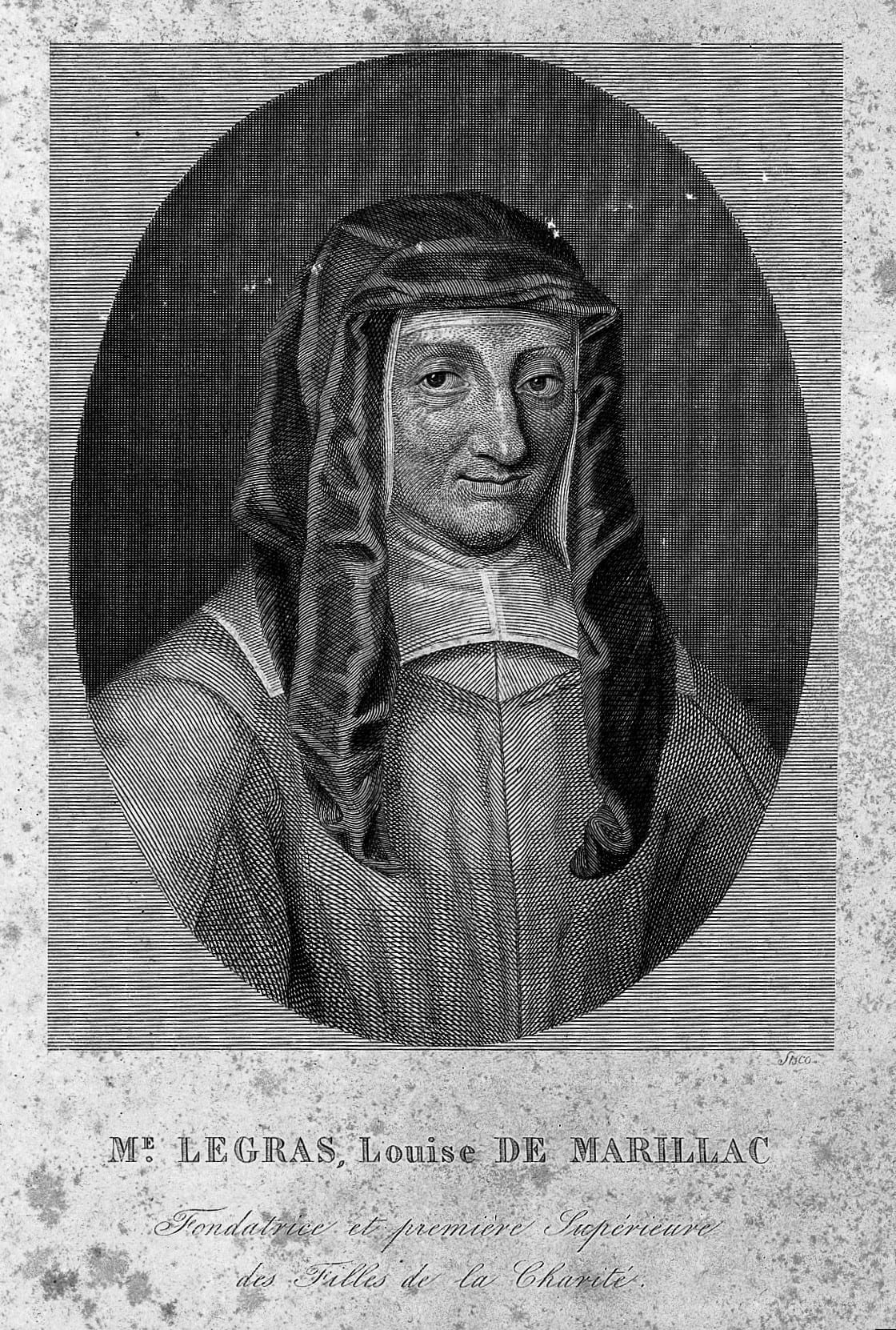
Louise de Marillac was the acknowledged illegitimate daughter of Louis de Marillac, a brother of the future Keeper of the Seals (Garde des Sceaux) of France and a member of one of the great Parisian magistracy families. She was raised at the family château, educated by the Dominican nuns of Poissy, and in 1613 was married to Antoine Le Gras, secretary to Queen Marie de Medici. The marriage produced one son, Michel, in 1613. After thirteen years and a long final illness, her husband died in 1625 leaving her a widow at thirty-four.
In 1624, on the feast of Pentecost, she had received a profound interior locution that she would 'be placed in the hands of a person whose face she would not see' for a great spiritual work she did not yet understand. Three years later, after her husband's death, she was introduced to Vincent de Paul by their mutual friend the Bishop of Belley — and immediately recognized in him the directing presence she had been promised. Vincent took over her spiritual direction in 1625.
From 1629 she travelled the French provinces with him organizing the rural Charity Confraternities. In 1633 — in the small Marillac apartment on the Rue des Fossés-Saint-Victor in Paris — she gathered four young rural women, the first of the future Daughters of Charity, and the institute was formally constituted. The Daughters were radical: no canonical enclosure (cloister), no religious habit (only the grey-and-blue working dress of the Île-de-France peasant woman, eventually with the famous winged cornette), no perpetual vows (only annual vows renewed each March 25). 'Your monastery shall be the houses of the sick' — Vincent's foundational instruction. By Louise's death in 1660 there were already forty Daughters of Charity houses across France and the Low Countries.
She co-managed the institute with Vincent for twenty-seven years from her room at the motherhouse on the Faubourg Saint-Denis. The two died within six months of each other — Louise on March 15, 1660; Vincent on September 27. Canonized 1934. Designated patroness of all Catholic social workers by John XXIII in 1960.