
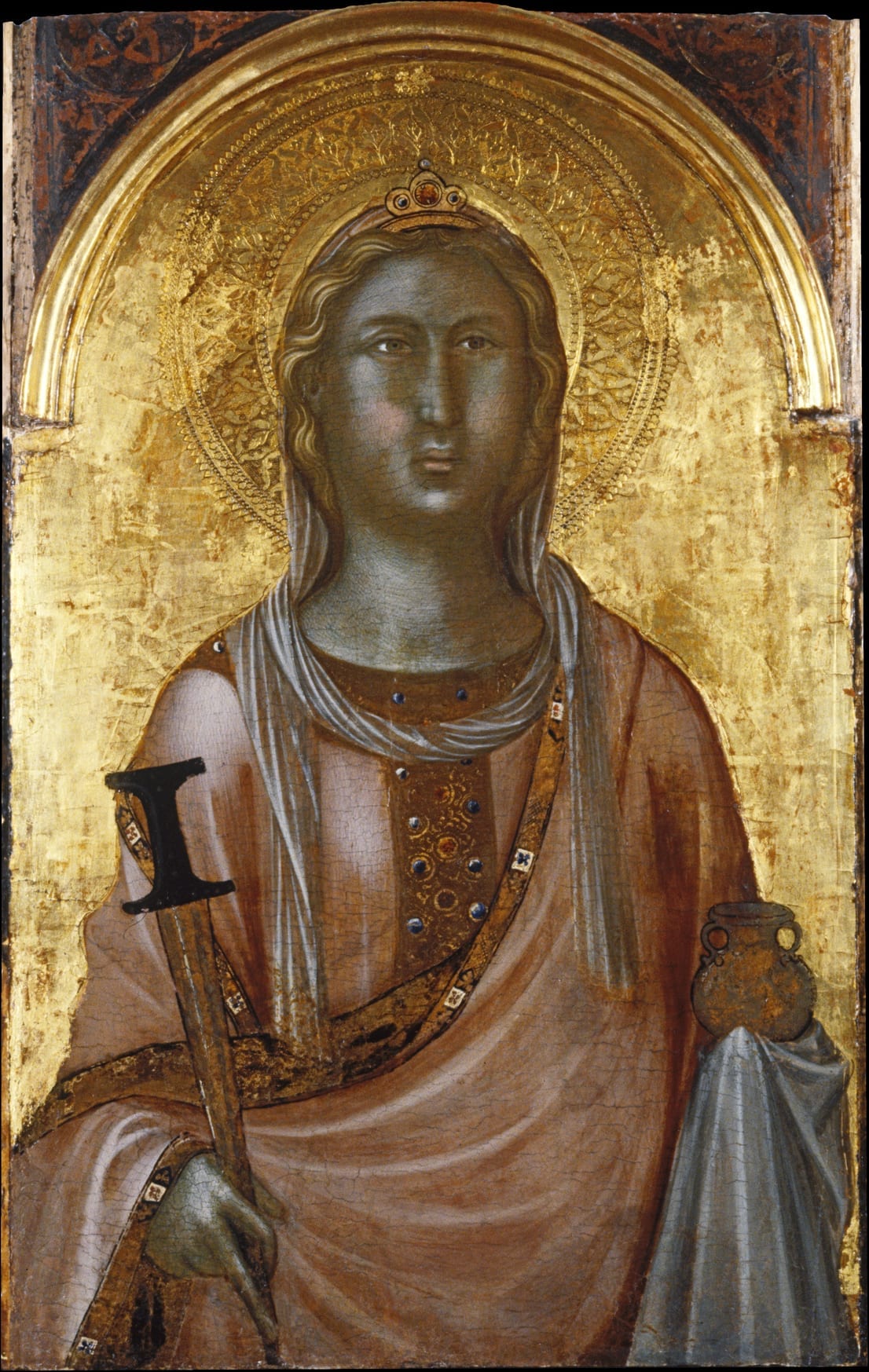
Lucy was the daughter of a noble Syracusan family. After her mother Eutychia, suffering from hemorrhages, was healed at the tomb of St. Agatha at Catania, Lucy persuaded her to consent to her vow of virginity and to distribute the family fortune to the poor. Her rejected suitor denounced her as a Christian to the governor Paschasius.
Condemned to be defiled in a brothel, the oxen sent to carry her could not move her. She was tortured with fire, oil, and pitch; none could harm her. She was finally killed by a sword-stroke at the throat. Her last prophecy was the death of Diocletian and Maximian and the peace of the Church under Constantine.
By the medieval tradition, her name being from Latin lux ('light'), and her feast falling on what was then the shortest day of the year under the old Julian calendar, made her the patroness of light. In Sweden and Norway, Lucia Day (December 13) is observed with girls wearing crowns of candles — one of the most distinctive surviving early-Christian saints' feasts in northern Europe.