
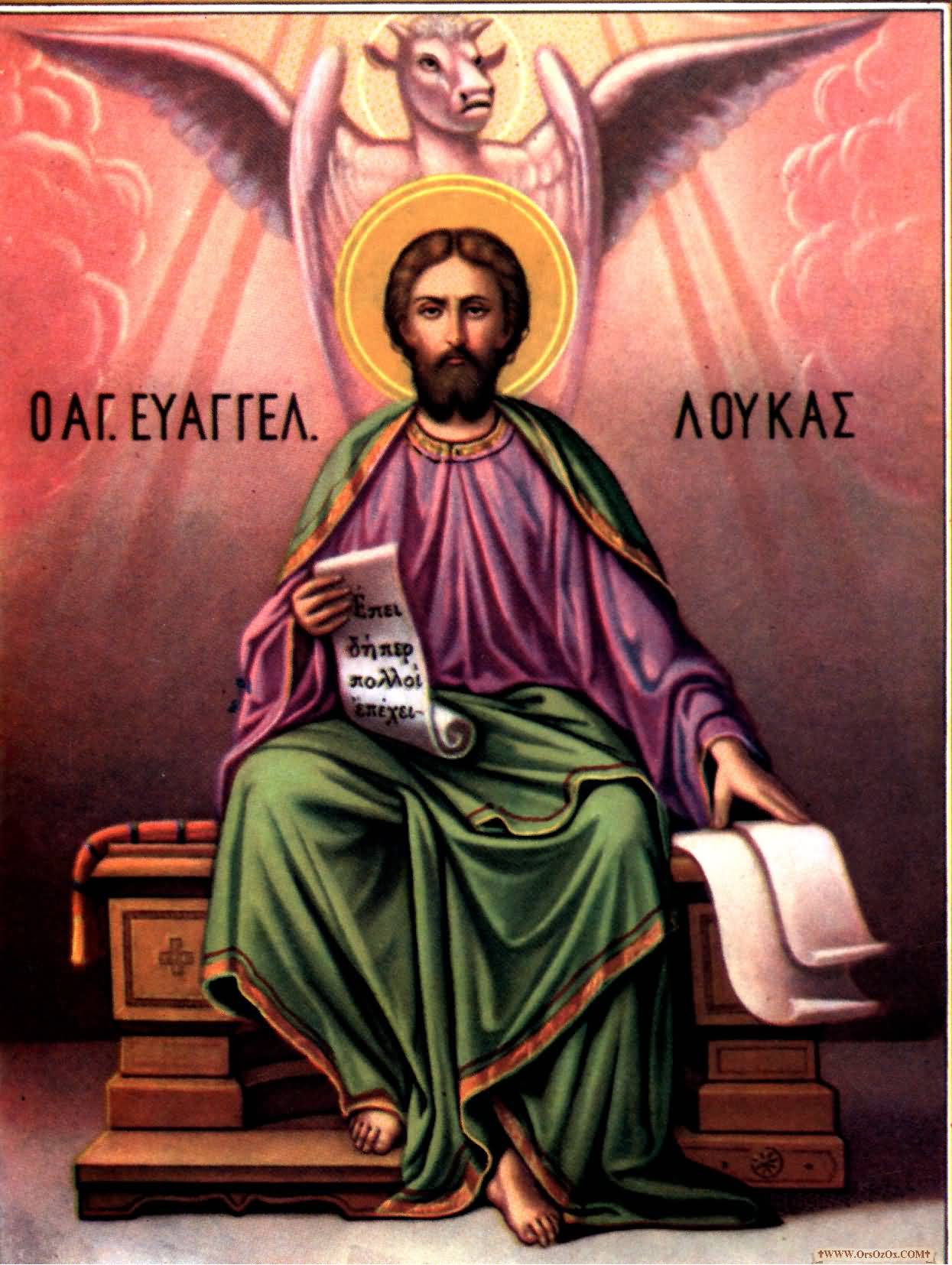
Luke was a Gentile, a Greek-speaking physician from Antioch in Syria — 'Luke, the most dear physician' as Paul calls him (Col 4:14). He joined Paul at Troas on the second missionary journey (the 'we' passages of Acts begin in 16:10) and remained his companion through the third journey, the imprisonment at Caesarea, and the voyage to Rome.
His two-volume work — the Gospel of Luke and the Acts of the Apostles — covers the longest historical span of any New Testament writing: from the Annunciation in the Temple of Jerusalem to Paul preaching at Rome thirty years later. His Gospel preserves the infancy narratives (the Annunciation, the Visitation, the Magnificat, the Nativity, the Presentation, the Finding in the Temple), the parables of the Good Samaritan and the Prodigal Son, the Beatitudes in the plain, and the appearance to the disciples on the road to Emmaus — material no other Gospel contains.
Tradition holds Luke remained unmarried, wrote his Gospel in Greece, and died there at eighty-four. His relics were brought to Constantinople by Constantine in 357 and later to Padua, where they rest in the Basilica of Santa Giustina. A skull relic is preserved at the Patriarchal Cathedral in Prague.
A medieval tradition holds he was the first iconographer of the Blessed Virgin Mary — that he painted her portrait from life, the original from which images such as the Salus Populi Romani (Rome) and the Black Madonna of Częstochowa (Poland) are descended. The historical truth of this is dubious; the devotional power undeniable.