
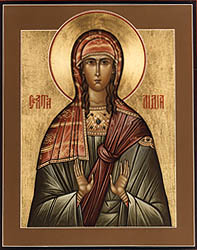
Lydia (Greek Lydia, possibly a personal name but also possibly a regional designation, 'the woman of Lydia') was a Greek-speaking businesswoman of Thyatira — a city of the Anatolian region of Lydia famous through antiquity for the production of high-quality purple-dyed wool, the most expensive textile of the Roman Mediterranean. She had emigrated to Philippi in Macedonia for trade, and was a 'God-fearer' (Acts 16:14) — that is, a Gentile attached to the Jewish synagogue community without formally being a Jewish proselyte.
On the Sabbath day of Paul's first visit to Philippi (c. AD 50 — Acts 16:13–15), Paul and his companions (Silas, Timothy, Luke — the famous 'we-passages' of Acts begin at Philippi suggesting Luke's first-person presence at the foundational event) went outside the city walls 'to the river, where prayer was wont to be made.' They found Lydia among the women gathered there, preached the Gospel to her, and 'her heart the Lord opened' (Acts 16:14) — the first recorded Christian conversion in continental Europe. She and her entire household were baptized in the small stream that flows from the city to the river.
She invited Paul and his companions to lodge at her house — the first European Christian house church — and her hospitality became the foundation of the Philippian Catholic community, the most beloved of all the Pauline churches (the Epistle to the Philippians records Paul's special affection for them). The small modern Baptistery of St. Lydia, built in 1974 on the stream where Lydia is believed to have been baptized, is one of the principal Catholic pilgrimage sites of mainland Greece.