
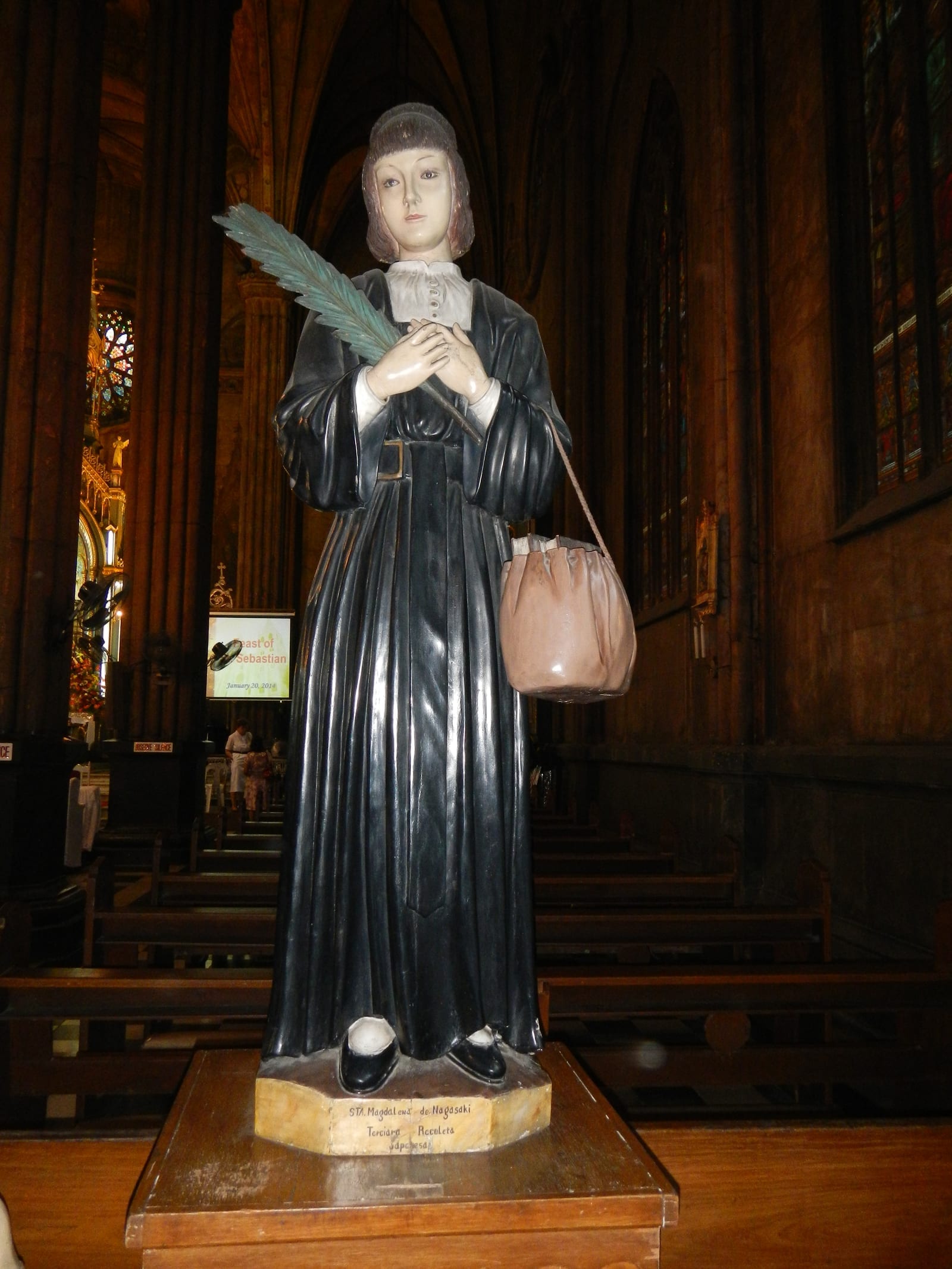
Magdalena was born to a Catholic family of Nagasaki — the great Japanese Catholic city of the early Tokugawa period — in 1611, fourteen years after the deaths of Paul Miki and the 26 Martyrs at Nishizaka. Her parents and elder sister had themselves been martyred during the 1620s persecutions under the second Tokugawa shōgun Hidetada. She was orphaned around 1620 at nine.
She was taken in by the small underground Augustinian Recollect mission of Nagasaki — the order, founded a century earlier as a Spanish observant reform of the Augustinians, had a small mission to Japan since 1604. She became a tertiary of the Augustinian Recollects (in religion: Magdalena) and worked as a clandestine catechist among the Catholic communities of Nagasaki through the increasingly violent persecutions of the late 1620s and early 1630s.
By 1634 the persecution had intensified under the third Tokugawa shōgun Iemitsu's anti-Christian campaigns. After the arrest and martyrdom of her two Augustinian directors (Francisco of Jesus and Vicente of San Antonio, executed at Nagasaki in 1632), Magdalena — then twenty-three — voluntarily presented herself to the Nagasaki magistrates and confessed her Catholicism. She was subjected to the tsurushi torture (suspension head-down over a pit, with a small cut at the temple to drain blood slowly) for thirteen days at Nishizaka, refusing to renounce Christ. She died on October 16, 1634 on the thirteenth day of the suspension at twenty-three. Canonized 1987 by John Paul II — alongside Lawrence Ruiz of Manila (see his entry in the 17th-c. supplemental catalogue) — as one of the 16 Lawrence Ruiz and Companions Japanese-Filipino Martyrs.