
Marcella (Latin Marcella) was the foundational figure of the famous Aventine circle of Roman patrician women who, in the late 4th and early 5th centuries, transformed their family palaces into informal monastic-scholarly communities centred on the study of Scripture and the practice of asceticism within Roman patrician life. The circle included — at various periods — Paula (see her entry already in the catalogue, born c. 347, who eventually emigrated to Bethlehem with Jerome), Eustochium (Paula's daughter, see her entry below), Asella (Marcella's friend), Lea, Albina, Furia, Fabiola, and others.
Marcella was widowed at twenty after a brief marriage and refused to remarry — turning down (per Jerome's biographical Letter 127 to Principia) the proposal of the consul Cerealis (who was, with all his immense wealth and prestige, the most eligible bachelor of the Roman elite of the day). She converted the great Marcellus family palace on the Aventine Hill into the first known Roman patrician house-monastery, gathering around her a community of consecrated widows and virgins.
From around 382, when Jerome arrived at Rome as personal secretary to Pope Damasus I, Marcella's house on the Aventine became Jerome's principal Roman intellectual-pastoral base. Jerome conducted in the Marcella household a sustained programme of Hebrew biblical scholarship: he taught Marcella, Paula, Eustochium, Asella, and others Hebrew (an unprecedented activity for Latin Christian women); he commented on the Psalms in their presence; and he conducted with them the foundational Hebrew text-critical work that would eventually produce his Vulgate Latin translation.
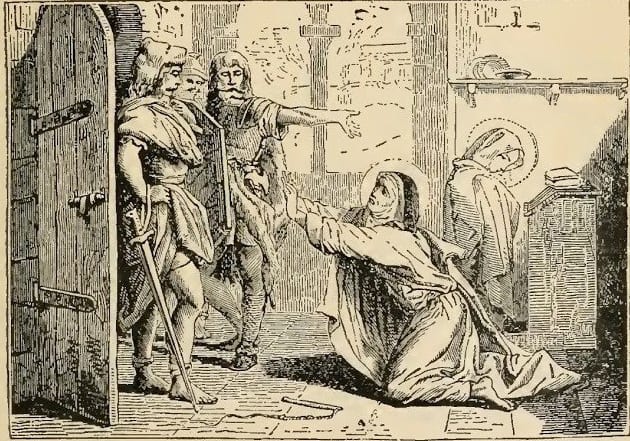
When Alaric and the Visigoths sacked Rome on August 24, 410 AD — the catastrophic event that prompted Augustine's City of God — Marcella was an elderly woman of eighty-five still living on the Aventine. The Visigothic troops broke into her house demanding the substantial wealth they assumed she had hidden. She replied truthfully that her poverty was complete (she had given all to the poor) but begged that her young companion Principia be spared the violence of the sack. She was beaten by the soldiers but survived; she died a few days after the sack, in Principia's arms at the Basilica of St. Paul Outside the Walls. Jerome's Letter 127 — written to Principia from Bethlehem in 412 — is the foundational biographical document of Marcella's life and of the Aventine circle.