
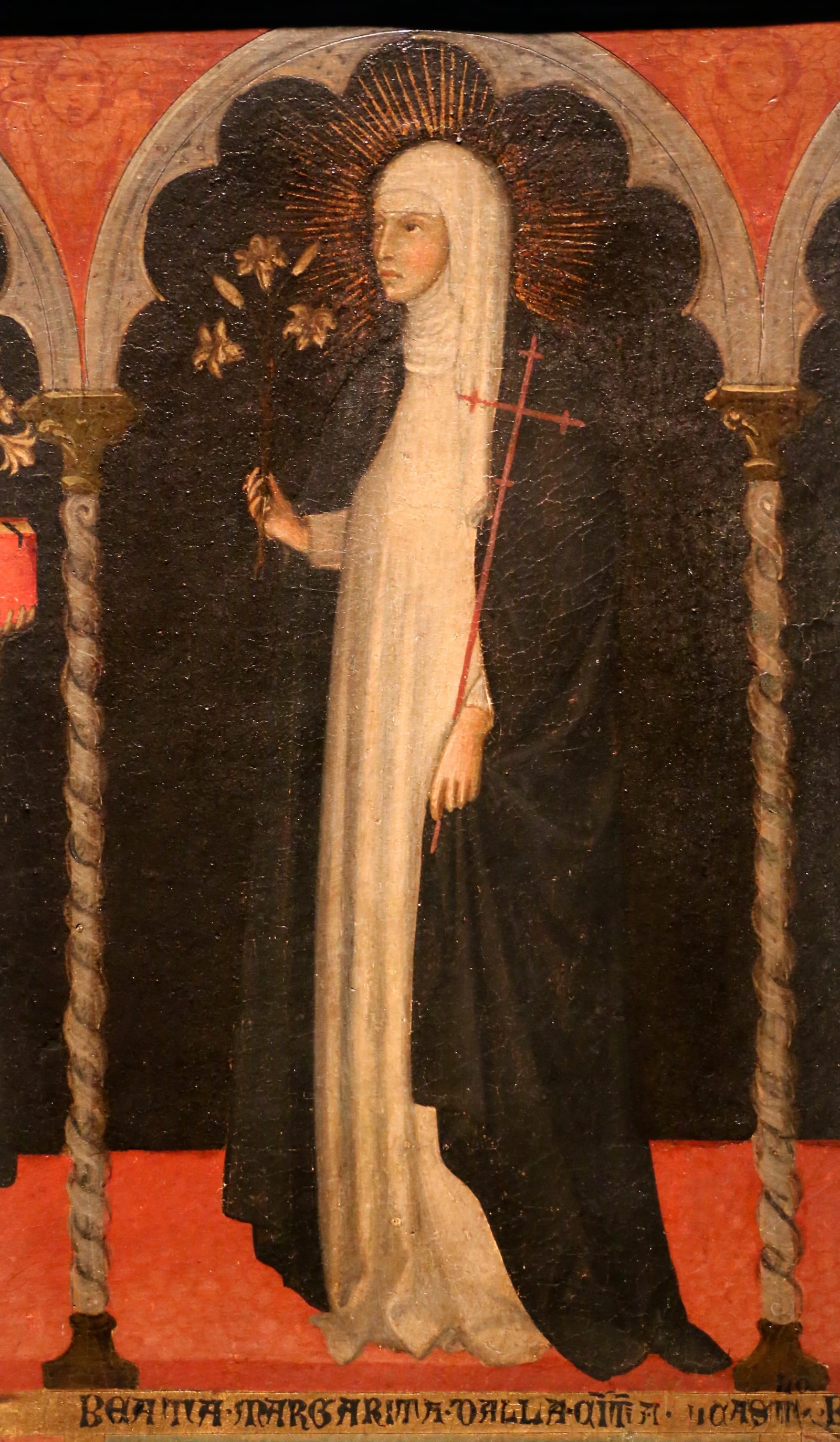
Margaret was born to a noble Umbrian family near Metola with a stack of disabilities — blind from birth, with a curvature of the spine (kyphosis), one leg significantly shorter than the other, and dwarfism. Her parents, ashamed of her appearance, hid her existence: she was kept walled into a small cell beside the family chapel from her sixth year onward, fed through a small window, taught the Office by the chapel's chaplain.
At sixteen, her parents took her secretly to Città di Castello in the hope of a miraculous cure at the tomb of a local Franciscan beatus. When no cure followed, they abandoned her in the streets of the town. She was found by Dominican beggars and taken in. She lived the remaining sixteen years of her life as a Dominican tertiary, sheltered first in a poor household and then in the Dominican parish: teaching the children of the neighbourhood (entirely from memory, blind), visiting the sick, the imprisoned, and the dying.
She died at Città di Castello at the age of thirty-three. The crowd that came to her funeral was so large the Dominicans buried her in the church itself — unprecedented for a layperson. Her body was found incorrupt at the translation and remains visible to this day in a glass casket on the high altar of San Domenico in Città di Castello. After seven hundred years of local veneration she was equipollently canonized by Pope Francis on April 24, 2021.