
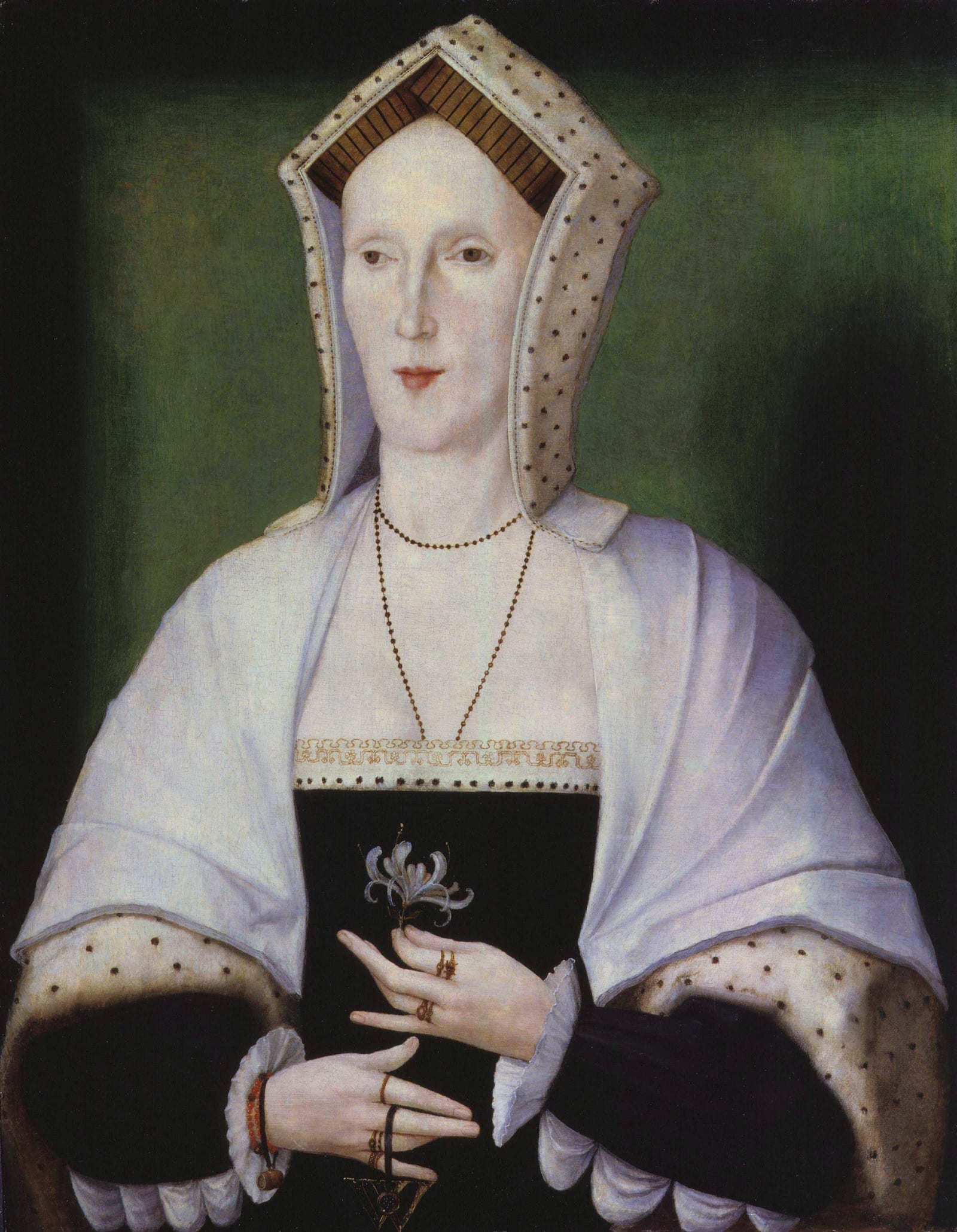
Margaret Plantagenet was the daughter of George, Duke of Clarence, and Isabel Neville — niece of Edward IV and Richard III, and the last surviving direct legitimate Plantagenet. Married in 1487 to Sir Richard Pole, she bore him five children, including Reginald Pole, the future cardinal and last Catholic Archbishop of Canterbury. Henry VIII restored her to her family titles in 1513 as Countess of Salisbury, the highest peerage of a woman in England — making her one of the wealthiest noblewomen in the kingdom and the personal governess of Princess Mary (the future Queen Mary I).
She fell into royal disfavour when her son Reginald, then at the Continental seminaries, published in 1536 the De Unitate Ecclesiastica — a public denunciation of Henry's Royal Supremacy and the divorce. Henry summoned Reginald home for execution; Reginald refused and fled. Margaret, her sons Henry and Geoffrey, and Geoffrey's family were arrested at Warblington in November 1538. Geoffrey betrayed family members under torture; Henry was executed in 1539. Margaret was held without trial in the Tower of London for over two years in conditions of severe deprivation.
In the spring of 1541 the king, in the panic of the northern Catholic-sympathetic Pilgrimage of Grace rebellions, ordered Margaret executed. She was beheaded on Tower Hill on May 27, 1541, aged sixty-seven. The headsman, an inexperienced apprentice (the regular executioner was away), required eleven blows to kill her — a botched execution that fixed her cult in English Catholic memory. Beatified 1886.