
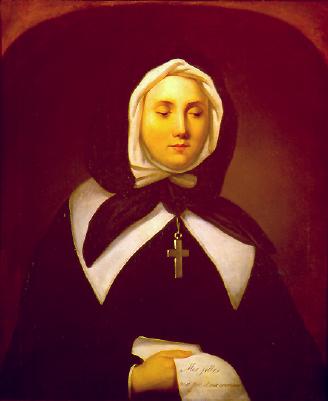
Marguerite Bourgeoys was a Troyes laywoman who served the Congregation of Notre-Dame externs (lay catechists) at her parish for ten years before being recruited in 1653 — at thirty-three — to come to the new settlement of Ville-Marie (the future Montreal) as schoolmistress. She sailed in 1653 with the second wave of recruits to the colony, arriving at Montreal in November of that year.
She opened the first school in Montreal in 1658 — in a converted stable on the colony's main square — and began recruiting and training other women catechists in a small community attached to it. By 1671, with the official authorization of the bishop of Quebec, she had formally established the Congregation of Notre-Dame of Montreal as an unenclosed teaching congregation specifically for the French colonial girls of New France and the indigenous Christian girls of the surrounding nations. Like the Daughters of Charity in France (with which Marguerite was well-acquainted), the Congregation was uncloistered, mobile, and dedicated specifically to teaching the poor.
She founded the Chapel of Notre-Dame-de-Bon-Secours in Montreal (the city's oldest surviving stone church, partially preserved in the present building) and the small Marguerite Bourgeoys School at Quebec, and travelled regularly to the Iroquois Mohawk village of Kahnawake to support the indigenous Catholic mission where Kateri Tekakwitha lived. By her death in 1700 the Congregation had expanded across Montreal, Quebec, and the small frontier settlements of New France — the principal Catholic women's teaching congregation of pre-Conquest Canada. Canonized 1982 — the first canonized woman of Canada.