
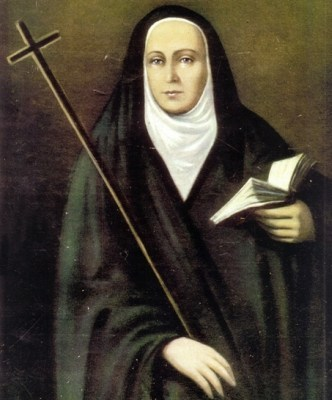
María Antonia de Paz y Figueroa was born in 1730 at Silípica, in Santiago del Estero, to a family of property in the old governorate of Tucumán. At fifteen she refused both marriage and the convent and took private vows as a beata attached to the Jesuit house in Santiago del Estero, taking the name María Antonia de San José. The beatas lived in community, prayed, and did the domestic work of the retreat house where townspeople came to make the Spiritual Exercises of St. Ignatius. Argentines shortened her name in Quechua fashion to Mama Antula.
In 1767 the Spanish crown expelled the Society of Jesus from all its territories. The retreat houses closed and the Exercises, the heart of Jesuit pastoral work, were suddenly without anyone to give them. María Antonia decided that a laywoman could keep them going. With the bishop's leave she opened a house in Santiago del Estero and began organising retreats herself, bringing in secular priests to preach and hear confessions while she ran the house.
Then she set out on foot. Dressed in black, with a Jesuit's mantle and a large wooden cross, she walked something like three thousand kilometres through the north-west — Jujuy, Salta, Tucumán, Catamarca, La Rioja — and reached Córdoba early in 1778, where about three thousand people made the Exercises in three and a half months. By the Dicastery's reckoning some seventy thousand people made retreats under her direction in eight years.
In 1779 she walked another fifteen hundred kilometres to Buenos Aires. The city took her at first for a madwoman and insulted her in the street; the bishop, once he had examined her, gave her wide authority. Her retreats ran ten days, with the parish clergy preaching; the poor were fed from alms her example drew in, so that the Exercises became a work of charity as much as of prayer. She also brought the devotion to St. Cajetan of Thiene, the saint invoked for work and bread, into the city.
Her lasting building was the Santa Casa de Ejercicios Espirituales on what is now Avenida Independencia, the retreat house she raised with donations and which opened in 1797. It is still in use, run by the Daughters of the Divine Saviour, the congregation that grew out of her beatas.
She died on March 7, 1799, at sixty-nine, and was buried without ceremony in the cemetery beside the church of La Piedad. Her remains were later moved inside the church, now the Basilica of Nuestra Señora de la Piedad del Monte Calvario, where they lie in a tomb the Argentine state declared a National Historic Sepulchre in 2014.
Pope Francis, who as Archbishop of Buenos Aires had promoted her cause, approved the beatification miracle on March 3, 2016; she was beatified at Santiago del Estero on August 27, 2016. The decree for the second miracle was signed on October 24, 2023, and on February 11, 2024 Francis canonised her in St. Peter's Basilica, the President of Argentina attending — the first Argentine woman raised to the altars. In his homily he called her 'a wayfarer of the Spirit' who 'travelled thousands of kilometres on foot, crossing deserts and dangerous roads, in order to bring God to others.'