
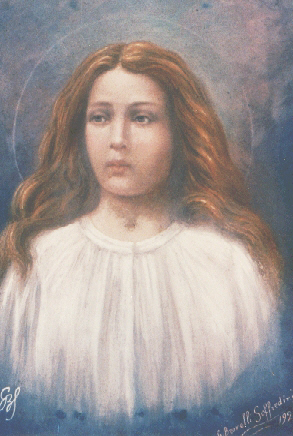
Maria Teresa Goretti was the third of seven children of a poor Marchigian sharecropping family. In 1896, when she was six, the family migrated south to the Pontine plain south of Rome — at that time a malarial, scarcely-cleared semi-frontier of the Papal States's old Agro Pontino. Her father Luigi died of malaria in 1900; her widowed mother Assunta supported the children by sharecropping with the neighbouring Serenelli family, who shared the small farmhouse at Le Ferriere outside Nettuno.
On the afternoon of July 5, 1902 — Maria not yet twelve, alone in the house mending her father's old shirt while her mother worked the fields — the twenty-year-old Alessandro Serenelli (son of the co-tenant family who had been making increasing sexual advances toward her over the previous months) confronted her with a long awl and demanded sex. She resisted, crying out repeatedly: 'No! It is a sin! God forbids it!' He stabbed her fourteen times with the awl. She survived for twenty hours at the small hospital of Orsenigo in Nettuno, repeatedly forgiving him from her deathbed in the presence of the priest, the surgeon, and her mother.
Alessandro Serenelli was sentenced to thirty years in prison. After his release in 1929 he travelled to her mother Assunta on Christmas Eve 1937 and begged her forgiveness. The two embraced and went together to midnight Mass at Corinaldo, where they received Communion side by side. Alessandro then made a public statement to the parish acknowledging his guilt and her sanctity; he attended her canonization in St. Peter's Square in 1950 — one of the few cases in church history of the canonized saint's murderer being personally present at the canonization. He spent the remaining years of his life as a Capuchin tertiary at the Macerata Capuchin friary, where he died in 1970. Maria Goretti was canonized June 24, 1950 — at the largest single open-air canonization Mass held in St. Peter's to that date (an estimated 500,000 attended).