
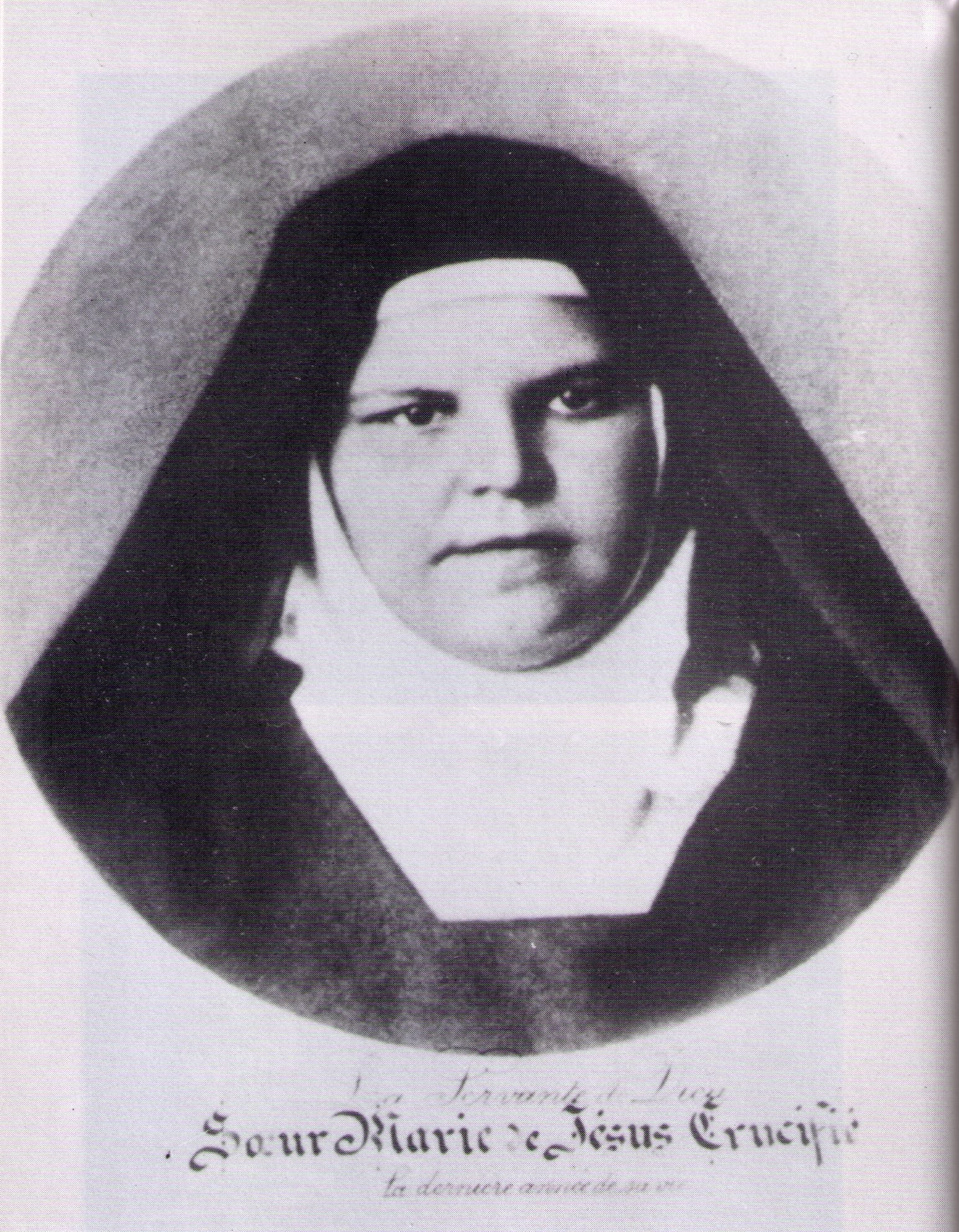
Mariam Baouardy was born to a Greek-Catholic (Melkite) Catholic family in the small Galilean village of I'billin near Akka — the youngest of thirteen children, all of whom died in infancy except Mariam and her brother Paul. Her parents — Giries Baouardy and Mariam Chahin — died of cholera when she was three; she and Paul were raised by an uncle in Alexandria, Egypt.
At thirteen the uncle attempted to marry her to a young Egyptian Catholic. She refused — wishing to enter religious life. Her uncle's male servant, attempting to persuade her to renounce Christianity (he was Muslim) and accept the marriage, in a fit of rage cut her throat with a sword on September 8, 1858 in the Alexandria garden. She survived through what she described as a healing vision of a 'Lady in blue' (which she identified as the Virgin Mary), who sewed up her wound and nursed her in a cave for a month. The scar — a deep five-inch laryngeal injury — was documented by physicians for the rest of her life as a major partial laryngeal-tracheal wound that should have been fatal.
Recovered, she worked as a domestic servant successively in Alexandria, Jerusalem, Beirut, and Marseille. In 1866 she entered the Sisters of St. Joseph at Marseille, but her unusual mystical phenomena (recurring stigmata, ecstatic states, levitations) made the community uncertain about her vocation. In 1867 she transferred to the Discalced Carmelites at Pau in southwestern France, made her novitiate, and was professed in 1871 — taking the religious name Mary of Jesus Crucified (Maryam Yasua' al-Maslub in Arabic). She was sent in 1875 to found the new Discalced Carmel at Mangalore, India — the first Discalced Carmel in India.
In 1878 she returned to Palestine to found a Discalced Carmel at Bethlehem (where the Catholic religious orders had been pleading for a contemplative women's foundation for decades). She personally directed the construction of the small Carmel at Bethlehem in the spring of 1878. She fell from a ladder during construction work on August 22, 1878, broke her arm in a complicated open fracture that became septic. She died of sepsis four days later, August 26, 1878 at thirty-two. The Bethlehem Carmel she had founded — now expanded to the original eight stone buildings — remains as the principal Catholic women's contemplative foundation in Palestine. Beatified by John Paul II in 1983, canonized by Pope Francis in 2015 — the first Palestinian-born canonized saint in modern Catholic Church history.