
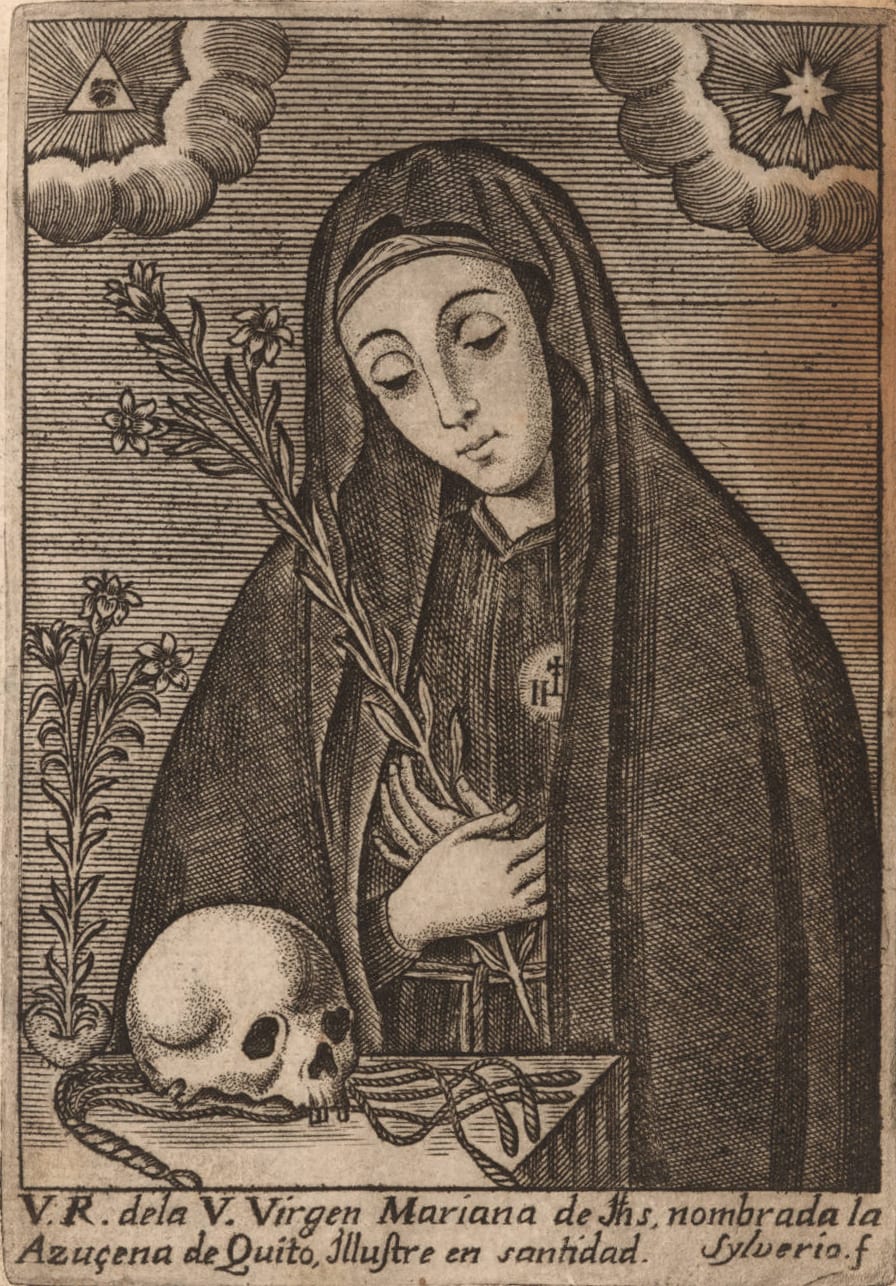
Mariana de Paredes y Flores was born to a Spanish-Andean noble family at Quito and orphaned at eight. Raised by her older sister and brother-in-law, she rejected several proposals of marriage and at fourteen began the unusual practice — for a noblewoman of colonial Quito — of living as an anchoress in a small cell in her sister's house. She took private vows of virginity and entered the Jesuit-administered Third Order at Quito (the Quito Jesuits had been active in evangelizing the city since 1586).
For the next sixteen years (1632–45) she lived in the small cell in her family home in continuous prayer, taking only minimal nourishment, sleeping on three planks for three hours per night, scourging herself, and supporting through her family resources a small free school for African and indigenous children in the city. She kept her hair entirely covered through these years; at her death it was discovered to have been pulled out by her by way of penance.
In April 1645 a series of devastating earthquakes shook Quito, followed by an epidemic of fever and plague that began to kill thousands of indigenous Quiteños. On the feast of Our Lady of the Rosary that May, in the Jesuit church of La Compañía, in the presence of the cathedral chapter and the civil magistrates, Mariana publicly offered herself to God as substitutionary victim for the city. The earthquakes and the plague ceased within days. She herself fell into a rapid decline and died at her sister's house on May 26, 1645. Canonized 1950 — the second canonized saint of the Spanish South American territories after Rose of Lima.